Showing posts with label Maps. Show all posts

Saturday, 28 March 2020

QGIS on Ubuntu 18.04

QGIS didn't work for me out of the box. Here's notes on what I had to do to get it going. Brief summary, out of the box the Open Street Map URL is missing. See 'Breakthrough' below for how to fix this. However, also, the version of qgis available from the Ubuntu package repository is at present quite out of date; alternative repositories are available but as yet I haven't tried them.

Firstly, if it isn't working and you've been tinkering to try to get it working, start by purging it completely:

sudo dpkg --purge qgis qgis-provider-grass qgis-plugin-grass
rm -rf ~/.qgis2/

Then reinstall it with all the extra bits that it actually needs - when I originally installed it, it did not automatically install saga, and I'm not sure whether it automatically installed the grass plugin.

sudo apt install python-qgis qgis-plugin-grass saga

This at the time of writing installs QGIS version 2.18.17.


Then start QGIS

qgis

QGIS, immediately on starting.
At this point the application window renders. I get one python warning in the 'Log Messages Panel':
2020-03-28T08:08:03 1 warning:/usr/lib/python2.7/dist-packages/qgis/utils.py:258: DeprecationWarning: This method will be removed in future versions. Use 'parser.read_file()' instead.
cp.readfp(f)

Because it's only a deprecation warning, I'm inclined to think this is not a significant issue.

I also get the following warnings in the console. Once again, they're only warnings:

Warning: loading of qgis translation failed [/usr/share/qgis/i18n//qgis_en_GB]
Warning: loading of qt translation failed [/usr/share/qt4/translations/qt_en_GB]
Warning: Object::connect: No such signal QgsMergedBookmarksTableModel::&QgsMergedBookmarksTableModel::selectItem( const QModelIndex &index )
Warning: Object::connect: (receiver name: 'QgsBookmarksBase')
Warning: QCss::Parser - Failed to load file "/style.qss"
QInotifyFileSystemWatcherEngine::addPaths: inotify_add_watch failed: No such file or directory
Warning: QFileSystemWatcher: failed to add paths: /home/simon/.qgis2//project_templates
Warning: QLayout: Attempting to add QLayout "" to QgsPanelWidgetStack "mWidgetStack", which already has a layout

I select, from the menus, Project -> New; the 'Recent Projects' heading disappears from the main pane, and it appears to be a map pane - but there's no map.

I type 'world' into the 'Coordinate' input and hit return, as directed by this tutorial, and still, no map. Comparing my screen to the screen shown in the tutorial, they are identical except that 
  1. No map is displayed, and
  2. Some icons in the second toolbar from the top which are coloured in the tutorial are greyed on my screen.
I take this to mean that not only can I not see the map, QGIS doesn't think there is a map from which I can make selections.

If I try to drag the 'osmraster' item from the 'Browser Panel' into the map area, I get a series of errors in the 'Log Messages Panel' of the general form:
2020-03-28T08:37:53 1 Tile request max retry error. Failed 3 requests for tile 11 of tileRequest 2 (url: https:/2/2/2.png)

Clearly, the URL is malformed. Clearly, there is something wrong with the template string from which the URL is being formed.

At this point I tried using the 'Getting Started' instructions from the manual. Once I had downloaded the sample data, I was able, following instructions, to get raster data to show on the map pane. Vector data, however, for example from the 'lakes.gml' file in the sample data, still did not render at all.

This made me suspicious of the error seen earlier in the console,

Warning: QCss::Parser - Failed to load file "/style.qss"

If the default style is white on white, then perhaps QGIS has been rendering a map, but rendering it invisibly. I find that there are indeed two files with this name in my file system:

simon@mason:~/qgis$ locate style.qss
/home/simon/.qgis2/themes/Night Mapping/style.qss
/home/simon/simon/.qgis2/themes/Night Mapping/style.qss
/usr/share/qgis/resources/themes/Night Mapping/style.qss

However, I can't find any way of selecting a stylesheet in any of the menus (there's a 'Style Manager' dialogue, available from the 'Project Properties' dialogue and from the 'Settings' menu, but it does not mention stylesheets and does not appear to allow you to set one. There's no reference to 'style.qss' in any file in my .qgis2 directory; nor is there any reference to it, or to a stylesheet at all, in a saved project file.

I experimentally copied one of these style.qss files into the root directory of my filesystem, and restarted QGIS. This time, the file was found, but its only effect was to render many dialogues unreadable; it did not change the blankness of the default map panel. Further browsing showed that a QSS stylesheet is a stylesheet used by the Qt tookit (which QGIS is built on), not used by QGIS itself, and, as the default styles render QGIS perfectly acceptably, this file is not needed and is not the problem.

At this point I noticed what looked like specks of dirt on the screen. I zoomed in and found a group of vector shapes which could well be lakes - but they didn't AT ALL align with the sample raster data. I checked the coordinate systems used and found that they were different. I changed the coordinate system for the lakes data to that used for the raster data, and they overlaid precisely. Progress!

The breakthrough

So I went back to trying to find why the Open Street Map data was not loading. I right clicked on 'Tile Server (XYZ)' in the 'Browser Panel' and got a dialogue asking for a URL. I entered 'https://c.tile.openstreetmap.org/{z}/{x}/{y}.png', chosen from an existing leaflet project, and was shown another dialogue asking for a name for the layer. I entered 'TestOSM'.

A 'TestOSM' entry appeared in the 'Browser Panel', and when I dragged this to the map pane, suddenly I had a map.

Epilogue

 
My takeaway from this catalogue of problems is that the QGIS package offered by Ubuntu is 
  1. Misconfigured, and
  2. Obsolete
I did get it working, and I've documented what I needed to do above; but it's clearly some way behind the current 'stable release', which is 3.10.4.

So I've spent a whole morning trying to install a more up-to-date version of QGIS. There are many repositories for more recent versions of QGIS out there on the Web, and many 'howto' articles explaining how to set them up and use them. I've tried many this morning, and my conclusion is that they're all, without exception, broken in one way or another. Some people do seem to have succeeded in getting a working install, but even their notes don't work. 
Furthermore, after doing that, it took an awful lot of work to sort out the mess and get back to a working 2.18.7. In summary, I believe it can be done, but it's not for the faint hearted.

Thursday, 27 February 2020

Putting data on the map

A couple of weeks ago, someone came to me with a problem. She had data in a spreadsheet. She wanted to display it as a map, on a website. And she wanted to be able to do that dynamically - that is to say, she wanted the map on the website to update as the spreadsheet changed.

So there were clear routes to several of the parts of this problem:

1. If you need maps on a web page, you need Leaflet - it's a simply wonderful library;
2. If you want a spreadsheet that is live on the Internet, Google Sheets are a very good way to go;
3. Google Sheets allows export as Comma-Separated Values, and CSV is a very easy format to parse.

I needed to do this quickly, so I started in my comfort zone, using Dmitri Sotnikov's Luminus framework and mixing in the Day8 re-frame framework, in order to have a lot of built-in functionality client side. The joy of the Clojure development tools is that getting a working system is as easy as typing

    lein new luminus geocsv +re-frame

And from that point on you can do your development with your system live, and can see the effects of every change you make immediately.

So within a couple of days I had a polished wee system which looked good and pulled live data from a Google Sheets spreadsheet to populate a map, with different graphical pins for her different classes of records. It was highly reusable, since you can specify the document id of any public Google sheet in the query part of the URL, and that sheet will be rendered. The map automatically pans and zooms to focus on the data provided. Was I pleased? Well, sort of.

Why was I not pleased? The deliverable component is an executable jar file, and it's 58 megabytes; in the browser, client-side, a page consumes 10 megabytes of memory. That seems huge for such a simple piece of functionality. I'd satisfied the requirement, but I hadn't satisfied myself. Also, of course, it needed you to be able to run a component on your web server, and many organisations with simple web hosting can't do that.

Doing it again, better

So I started again. This time I did it entirely client-side, just ClojureScript, with no heavyweight libraries. Having solved the problem once, it was pretty easy to do it again, and within a day I had a system working. Furthermore, I added flexibility: you can supply a URL, as before; or as the text of the document element that the map overlays; or passed as a string to the function. You can see it here.

Was I pleased?

No.

Three things about this solution don't satisfy me.

Firstly, the deliverable (jar archive, for direct comparison with the original) is still 2.9 megabytes. That's only 5% of the size of the original, and includes the whole of Leaflet, the whole of [Papaparse](https://www.papaparse.com/) - a client side CSV parser, and 398 different map pin images, but it still seems big. Page load - with the three maps on the demo page - costs around 5 megabytes in the browser.

Secondly, because it's client-side only, it cannot know what pin images are available on the server; so if there is a category value in the data for which no pin image is available on the server, you will get a 'broken image' appearing on the map, which is ugly.

Thirdly and most significantly, again because it's client side only, modern cross-site scripting protections mean that it cannot pull data from a spreadsheet hosted on another site - so it doesn't strictly meet the original requirement.

Iterating again

I decided to look at whether I could make it smaller by abandoning the comfort of the Clojure environment and writing pure JavaScript. This led to a third iteration, geocsv-js, which you can see in action here. The amount of 'my code' in this version is far lighter - the output of the ClojureScript compiler for geocsv-lite comes to 6.6 megabytes uncompressed, whereas the pure JavaScript version is one file of just 8.8 kilobytes in 296 source lines of code (for comparison, the ClojureScript solution, geocsv-lite, comes to 372 source lines of code). One reason for the slightly larger size of the ClojureScript solution is that it has a better algorithm for panning and zooming the map to display the data actually entered, which I didn't port to JavaScript.

But what is bizarre and I do not yet understand is that the deliverable is not smaller but bigger than the geocsv-lite deliverable, by almost twice - 4.7 megabytes - despite using identically the same libraries. Still more surprising, the memory consumption in the browser is also higher, at around 6 megabytes.

What are the lessons learned? Well, the overhead of using ClojureScript is not nearly as much as I thought it was. There is something clearly wrong about the discrepancy between the size of the packaged deliverables - the pure JavaScript variant must be including third party data which the ClojureScript variant doesn't, although I haven't yet tracked down what this is - but the in-browser memory footprint is actually smaller, and the page load time is, as best as I can measure, identical at about five seconds.

Was I satisfied now? Well, sort of.

Merits and demerits

All three variants have merits. The first pulls the data directly from Google Sheets, which was the original requirement, and served a default pin image for any record category for which it didn't have a matching image. That made it a lot slicker to use, and more forgiving of user error. The two client-side-only variants cannot do those things, for reasons which I have not found ways to solve. But they don't need any server-side functionality beyond the dumb serving of files, so they're much easier to deploy; they are also less greedy of client side resources.

One more time with feeling

One of the reasons why I kept on hammering at this problem was that I felt it would make a really useful extension for my wiki engine, Smeagol. I've integrated the JavaScript version, geocsv-js, and in doing that I've solved a number of problems. Firstly, the look and feel and content of Smeagol pages is flexible and easily configurable by the user, so it doesn't take a geek to set up a page with the content you want and a map of the data you want to show. Secondly, the Smeagol engine, because it sits server side, can pull data from remote sites, and because it doesn't interpret that data, there's no significant risk in doing that. Thirdly, again because it sits server side, it can deal with the issue of unknown images - and, because it's a wiki engine targeting less technical users, I've deliberately made it very graceful about how it does this.

So now, instead of just a map on a web page, you get a whole, richly editable website, with existing extensions to integrate sophisticated data visualisation and photograph galleries as well as maps. And the cost of this? Surprisingly little more. A Smeagol page with one map uses exactly the same memory on the client as a geocsv-js page with one map, because Smeagol now only loads JavaScript for extensions actually being used in the page, and almost all of its own functionality runs server side. But even server side, the cost is not very much greater than for the full fat geocsv implementation - the deliverable jar file, which offers far more functionality than geocsv, is only 88 megabytes. Considering how much more usability and flexibility this offers, this is the version of geocsv I'd now offer, if someone came to me with the same problem.

Thursday, 13 April 2017

A really interesting map of Scotland

The map at just over 1,000 signatures
I've blogged before - a number of times - on maps which show the systematic difference in political culture between Scotland and England, but here's a really interesting one. This map shows the early signatories to a petition against the 'rape clause'. Why, on this issue, should there be such a sharp divide between Scotland and the rest of the UK?

Yes, OK, the campaign has been led by Alison Thewliss, an SNP MP. Yes, Nicola Sturgeon did reference it in her barnstorming interview at the Women in the World summit in New York. But this is a clause which affects women across the UK, a clause so perversely evil that it must surely offend people of any gender across the UK.

So why is Scotland so clearly delineated?

Obviously, this is early days; the petition has barely more than a thousand signatures. But it will be interesting to watch it over the next few weeks. Is Scotland not only left of the rest of Britain, but also more feminist?

Update, 14th April

Here's the map at almost 4000 signatures (coloured by % of constituents). Can you still see the Scottish border?
The map at almost 4,000 signatures

Update, 16th April

Now at 16,000 signatures, and still every constituency in mainland Scotland has more signatures than any constituency outside Scotland.


Wednesday, 27 July 2016

Witcher III: Poland's astonishing cultural achievement

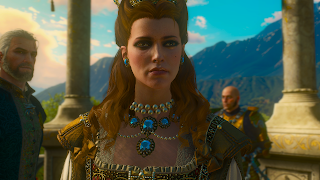
Anna Henrietta
Last night I managed to get Anna Henrietta, Duquessa de Toussaint, killed.
I didn't mean to. I intended exactly the opposite. And in the moments after she was assassinated I rocked back quite literally, thinking 'my God, what have I done?'

I could have prevented her death. I did - clearly - know the risk. I had even alerted the captain of her personal bodyguard to it. But I did not tell the Duquessa herself, and I could have done so. I did have the opportunity.

Today, I have been thinking through the scene again, and come to the conclusion that, despite the dreadful consequence, I had made the right decisions. Geralt must believe in the possibility of redemption; otherwise he is not a monster slayer, he is just a monster.

Geralt?

When you play computer role playing games, you very often have great latitude to choose the character you play as. As such games have become increasingly voice-acted, it's no longer possible in many to choose the name of the character you play as; in the Mass Effect series, for example, you play as 'Shepard', but you may play as male or female, and have a wide choice of character traits.

But in The Witcher series of games, you play as Geralt, and Geralt is not malleable. He has an established character, created over a series of post-modern fantasy novels set in a dystopian eastern European by a highly regarded Polish writer, Andrzej Sapkowski. If you're not familiar with his work, the nearest thing in English literature would be Angela Carter.

Sapkowski uses his fairy tale world to talk about dark themes: ethnic and religious war, pogroms, genocide, ethnic cleansing, evil and redemption, the conflict between free will and destiny or fate. He does this centrally through the adventures of Geralt, a 'Witcher', or itinerant pest control operative.

Witchers, in his world, are a guild of specialist hunters, hunting and killing such magical pests as ghouls, draconids, vampires and so on. They do this largely for hire. Witchers are uncommon partly because the training is extremely arduous and involves the use of performance enhancing drugs which are toxic and cause the deaths of many trainees, and partly because religious cults view them as abominations.

Within this framework, Geralt, as he emerges from the novels, is a terse, hard-bitten man who affects cynicism but is deeply concerned with the morality of his actions; who is at once serially promiscuous and at the same time has strong loyalties to several lovers and a magical quasi-monogamous bond to one in particular, a sorceress, Yennefer of Vengerberg.

In playing The Witcher games, you play as this character, and it's my experience that whether you intend to or not you will gradually inhabit this character, thinking hard about making the decisions that Geralt would make. Because the greatest strength of the series - and they have a galaxy of strengths - is the moral ambiguity of the world. Decisions are hard. There are no clear blacks and whites. There are uncertainties. It is a world in which you - you playing as Geralt - must do the very best you can, knowing that whatever you do you may not be able to prevent bad outcomes.

The death of Anna Henrietta is a case in point. As a child, her sister, Silvia Anna, was believed to be cursed, having been born during a solar eclipse. As such she was considered to be evil, and blamed for everything that went wrong. Sometime in her late childhood or very early adolescence, her parents had ordered a group of knights to take her deep into the wilderness in winter, and abandon her there. There is an implication that the knights raped Sylvia Anna before they abandoned her.

Many years later, Sylvia Anna has returned. She has, by a process of blackmail and deception, had the knights who took her out to be abandoned hideously murdered. If you follow the path through the plot that I followed, you have foiled her further plot and have captured her; you know for certain that she's manipulative and cunning, and, crucially, you know that she had intended to kill her sister.

Is Sylvia Anna evil because she was born during a solar eclipse? Or is she angry and vindictive because of how she was treated as a child?

On the other side, Anna Henrietta is an absolute ruler, spoiled, arbitrary, passionate, given to management by tantrum; when her sister accuses her of a lack of compassion it's hard to disagree with that charge. Anna Henrietta, as the younger sister, was a child when Sylvia Anna was abandoned, and didn't become ruler until some twenty five years later. Nevertheless, it's true that since she became ruler she hasn't done anything to find out whether her sister really did die, certainly hasn't sought her out.

However, in a world where war, genocide and pogroms are widespread, Anna Henrietta's quasi-independent duchy is relatively speaking extremely well ruled. There is no war. There is no starvation, although there are a few beggars. There is order and a certain degree of justice. Anna Henrietta is, then, no paragon; but, within the context of her world, she's a better ruler than most. There is also no obvious succession, so the potential consequences of Anna Henrietta's assassination are all the more dire.

In this situation, should I let an attempted reconciliation between the sisters go ahead?

I did. I encouraged it.

I believe that is what Geralt would do. More, I believe it is what Geralt should do. More yet, it is what I, playing as Geralt, would do again.

Because it is right that the spoiled, fortunate, successful sister, having chosen against character to show love and compassion, should have an opportunity to do so. And it is right that the despised, outcast, sinned-against sister should have the chance to repent her own sins and find redemption.

It was, I say again, the right decision for Geralt to make, and I, playing as him, made it. And he, and me playing as him, are responsible for the consequences.

So, one decision. One hard decision, on the outcome of which two women die who did not need to die, and a peaceful duchy is brought to the brink of civil war. A hard decision which you take with careful seriousness, and which afterwards you rethink and rethink and rethink - how could I have played this differently? A real moral dilemma, a genuinely engaging piece of action. Is this what makes The Witcher as a game?

Yes, a thousand times. Because over the course of the series there are certainly hundreds, probably thousands of decisions of equal weight. Story telling, character, and the agency of the player to act within the story and by so doing change its outcome of the story. Moral ambiguity, hard decisions, are, as I said, the greatest of the many great strengths of this series of games.

What are the others?

Toussaint, the duchy over which Henrietta Anna rules and in which the tragedy of the two sisters plays out, forms an epilogue to the plot of of  The Witcher III: The Wild Hunt. It is a sort of idealised Languedoc, strikingly reminiscent of Guy Gavriel Kay's Arbonne; it's stunningly beautiful, a limestone landscape of bright sunlit days and lambent nights, among vineyards, olive groves, sunflower fields, forests and open maquis, full of castles, comfortable homes and ancient ruins, and centred round the beautiful - and beautifully realised - city of Beauclair. Simply riding through the land of Toussaint is sometimes startlingly reminiscent of watching the Tour de France - the landscape is that well realised.

And it's peopled with wonderfully rich characters. Foppish knights, philosophical vampires, a most engaging boot-black.
Beauclair
But this richly beautiful environment isn't the world of The Witcher 3; it's an afterthought, an indulgent bit tacked on at the end. The majority of the action of the story ranges across the war-ravaged landscape of the northern realms, as competing minor kingdoms, faced with determined invasion by a much more powerful southern empire, instead of uniting fall into internecine chaos.

Across this scarred and blighted landscape Geralt's adoptive daughter is hunted by powerful magical enemies. The action of the main plot is to track her down, to gather allies who can together overcome these enemies, and finally to confront and defeat them. Not then, in itself a hugely compelling plot; but as this main plot drags you across the world it throws you into a series of other plots, stories and dilemmas.

What hits you about any of The Witcher games is the extraordinary beauty and conviction of the game world. Everything is believable; the world has very few artefacts which break the willing suspension of disbelief. For example, signposts are used in this third game as fast-travel points, which is convenient but unnatural, but they look just like one would expect medieval signposts to look. In fact, I very quickly stopped using fast travel; the world is so beautifully realised that it was an actual pleasure to ride across it, enjoying the scenery and happening upon new adventures organically.

The world is a reimagining of thirteenth century Europe in exactly the same way that Arbonne, or Lois McMaster Bujold's Chalion are. But it is very specifically a Polish reimagining, and in that reimagining are remembered the brutal crusades of the Teutonic Knights, the history of pogroms, the savageries of the thirty years war and of the Nazi holocaust. All these and more are distilled with the grimmest of fairy tales into this landscape - a landscape of abandoned battlefields, of heaps of corpses, of roving bands of deserters and bandits, of terrified refugees, of feral orphaned children, of carrion-eaters, smugglers, spies, guerrillas, warlords. But it's also a landscape of orchards, forests, swamps, rivers, farmlands, villages and cities.

To say this world is of extraordinary beauty is not to say it's a world of sweetness and light; on the contrary it's a world of war, massacre, genocide, terrorism, despotism, fundamentalism - and a world filled with every monster and supernatural being from a broad sweep of European folklore. This is strictly adult art, and not because it includes sex scenes (although, yes, it does). It's adult because it includes scenes of extraordinary and visceral brutality. For example, the scene which plays when the player first enters the main square in the free city of Novigrad is a real, bloody horror.

Amidst all this is a great deal of satire and wit. I greatly enjoyed my visits to the university town of Oxenfurt, although even there the academy is closed because the local ruler wanted the young men for his war effort, and because the fundamentalist sect he encouraged wanted the books burned.

There are few bugs. Your horse, Roach, will very occasionally get stuck somewhere improbable, or will put his head through an apparently solid wall. I once saw a monster - a harpy - stuck in a wall. In over one hundred hours of playing the game has crashed only once.

Sailing boats always seem to have the wind behind them, even if you sail in circles.

There are also usual issues I complain about in all games of this genre. As characters have become increasingly voice acted - in common with many modern games, this one is entirely voice acted - so the richness of interaction has declined, because it is much more complex and time consuming to voice-act deep dialogue trees than simply to script them. So the vast majority of non-player characters you encounter have no conversation at all.

Partly in consequence of this, there are too many situations where the only way to deal with an opposing character is to kill them - and it would be very difficult to get through the game without killing many people, who are often little more than petty criminals or soldiers of a tyrannical king. It would, for me, have been improved either by having better ways of negotiating a way through potential conflict situations, or of using stealth to work round them.

There's another downside to voice acting. It seemed to me - and I may be wrong - that Shani, a character I'll come back to later, was voiced by a different voice actor in the third game. This obviously is a minor point; but together with a subtly updated character model (which actually isn't unreasonable - Shani would be ten years older, although she still seems very young) it made a character whom I felt I knew well and very much liked suddenly unfamiliar, and, as such was jarring.

A final issue before I stop carping on about voice acting. It's clear that lip-synch for the game is not to the English text (I imagine it's to the Polish text, and it's quite reasonable that it should be). In many conversations, characters go on apparently speaking silently for significant periods after the English language speech has come to an end. So I had an uncomfortable feeling that there were probably subtleties and nuances in the original Polish script that were quite literally lost in translation.

There's a more serious issue, for me, with the characterisation of Geralt's potential love interests. Partly this goes back to Sapkowski's books. Geralt's primary lover, and most of his incidental lovers, are sorceresses; this is taken from the books. Also taken from the books is the fact that the sorceresses, as a class, are manipulative, devious, ambitious, vengeful and deeply engaged in the internecine politics of the northern kingdoms.

Again, from canon, Geralt is bonded to Yennefer by a magic bond which he himself chose to make. He cannot help but love her (and she him), but this is because of a wish which Geralt himself made to resolve a serious problem with a djinn. He had to make a wish, but he did not have to make that specific wish. So Geralt is bonded to Yennefer, but because he has chosen to be.

The problem for me is that Yennefer as realised in the game is not a particularly likeable person. She's certainly very beautiful, but she's also certainly manipulative. She's on balance good, and she does help out when the going gets tough, but she also certainly uses Geralt. In the course of the game, Yennefer undoes the magic bond, so that she and Geralt are no longer magically constrained to love one another. And really, when you don't have to, I don't see why you would.

This is, as I've said before, not really a problem with the game. The game does realise the character of Yennefer very much as she is drawn in the novels. It's just that the game doesn't show you - or at least, didn't show me - why Geralt would choose her.

This issue is for me conflated because the alternative love interest in the main plot is Triss Merigold. Again, she's a sorceress. Again, she's a character taken from the novels, with her own canonical past. From the novels we already know that she and Yennefer are friends. But, in the sequence of games (which if you're playing this third game, are also sort-of canon), in the first game, in which Geralt was suffering from amnesia, she was also a main plot love interest. In character she's remarkably similar to Yennefer - she's arrogant, manipulative, and (in both the first and third games) uses sex with Geralt essentially transactionally to get him to do things that she wants done.

In this third game - at least, following the path I followed - Triss seemed to be drawn as a slightly warmer, slightly more sympathetic character than Yennefer. It has to be said that in my game I chose Yennefer, not Triss; if I'd made the other choice perhaps I'd have a slightly different view (and I do intend to play through again in order to find out).

But the fact is, for me, these characters are very similar. If you wouldn't choose one, why choose the other? There are many female characters in the plot who are at least equally attractive and who seem just much better people. I'd mention two in particular: Cerys an Craite, one of the candidates for the vacant kingship of the isles of Skellige, who I thought a genuinely serious, thoughtful, thoroughly likeable person (I supported her candidacy, and saw her elected); and Shani, the other main-quest love interest from the first game (in the books, Shani is never a lover of Geralt's, but does have an affair with his even more promiscuous friend and amanuensis Dandelion).

Shani is a sort of thirteenth century Medecins sans Frontiers; she's a dedicated doctor who practices her trade in plague hospitals and on battlefields. She is again presented as a serious, thoughtful, warm, generous person, and is in my opinion definitely the better of the two choices of love interest in the first game. In the third game, however, she appears only in an epilogue, and, in that epilogue, although there is a path for Geralt to have a casual liaison with her, there does not seem to be (or I did not find) a way to build that into a more settled relationship.

My 'big' computer is, even by today's standards, quite powerful (i7, eight core, 3.2 GHz, 16Gb RAM), and has a fairly good graphics card. I was able to play through the early part of the plot on very high graphics settings, and, on those very high settings, the visual beauty is remarkable. However in the crowded, incident filled streets of Novigrad the graphics performance started to struggle, and I had to turn the settings down a bit. I never turned them up again, because actually on medium settings it's still extraordinarily beautiful and runs without stuttering. Nevertheless it would be interesting to play it with a really top-end modern graphics card to see how much difference it made!

So, minor flaws. Very minor.

But how does one sum this up?

It's an astonishing achievement. A work of art bigger in scope than a dozen feature films, than a handful of novels; as big in scope as one of the modern blockbuster TV series such as Game of Thrones. But, in contrast to any of those things, this is not a linear narrative. Instead, the consumer - the player - is deeply, personally involved in the plot, making thousands of decisions which will affect the fates of characters and of nations. And amidst all that complexity and variability, the story not only must play out to a satisfactory conclusion: it does do so.

I never noticed a building model which had been reused (although the world contains, certainly, tens of thousands of buildings); if plant models were reused (and I'd assume they were) again, I didn't notice it. A few character models are reused, but mostly these are uniformed guardsmen (for example) who would look alike. The only voice character model I noticed being reused was one merchant. The depth and richness of the art needs to be experienced to be believed.

I've described the very broad outline of the plot, and story-telling. I've described a few of the hundreds of characters. I've sketched a few elements of the scenery. I haven't begun to describe the wonderfully realised and varied architecture, the glorious sound track, the superb animation.

I took a fairly direct route through the main plot, and then played both the Heart of Stone and Blood and Wine extensions. There are many subplots and sidequests I haven't yet explored, and, of course, there are combinatorially many hundreds of thousands of alternative paths I could have taken through the main plot (although there will be at most only a few tens of these which are very substantially different).

The score system says that, in over 100 hours of playing, I've explored only 36% of the world, and I'll believe that. Thus, compared to something like, for example, all the box sets of the Game of Thrones television series watched end to end, this is substantially bigger. Size, of course, is not quality; but the combination of the quality - which I hope I've conveyed - and the scope make this an epic, a monumental, cultural achievement.

If you're at all interested in story telling, in fairy tales, in European history, in modern literature, I urge you very strongly to experience this game.

Tuesday, 26 July 2016

More maps of Scotland


I've posted about maps of Scotland before; if you follow the different aspects of this blog you'll know I'm rather interested in maps. In June I posted the EU referendum results map. It sharply delineates Scotland. So too did maps of opinion on Europe prior to the vote.


Professor Jim Gallagher opines in the Herald today that this clear difference of opinion does not indicate that Scotland is any different from England. I'd disagree, but let's look at some other maps.

Here's another - apparently unrelated - map: where people petitioning for Tony Blair to be arraigned before Parliament for the war on Iraq come from:

And of course there are more. Here's a quick selection:


Of course you may reasonably claim that (apart from the EU referendum, which we've seen before) since the first shows the General Election outcome (SNP landslide in Scotland), while the remaining two show the consequences of that outcome in key parliamentary votes. Nonetheless, they're stark.

Here's another. Once again, the border between England and Scotland is sharp and clear - and the border between England and Wales completely invisible. Can you guess what this is?


That's a map of the proportion of UKIP voters.

Summary: Scots are significantly more pacifist (oppose Trident, seek accountability for war crimes), less anti-immigration (low UKIP vote), more internationalist (support EU membership), and all these things are equally true across the whole of Scotland - even the Conservative-voting areas - while being sharply different from the overwhelming opinion across England.

In summary, the learned professor is just plain wrong: Scotland is markedly and systematically different from England.

And one more

Edited in August 2018 to add one more map which I particularly like. This is data from the 1997 devolution referendum. The areas coloured red (see scale) are those which voted 'No'.

I wonder if you can find them?
By MrPenguin20 - Own work, CC BY-SA 3.0, 
https://commons.wikimedia.org/w/index.php?curid=31221638


Update on Brexit, November 2018

This is Survation data from November 2018. Although much of England has swung to Remain, the border is still clearly visible, with all of Scotland still much more Remain than almost anywhere in England.
Survation Brexit data, November 2018

Another update on Brexit, March 2019

This is a map of the signatories to a petition for a no deal Brexit, 27th March 2019.


And yet another, this time on the Monarchy, January-November 2019

This one pleases my republican heart greatly. It's based on unusually solid data - 21,119 respondents. Constituencies supporting the monarchy coloured green, those opposing, pink.

And one on Covid tests, September 2020

Again, very pleasing to me. The Times describes this as 'a lottery'. Does it look like a lottery to you?

Another Covid map, November 2020

This one makes me sad. New cases by council area, in the past week. Taken from Travelling Tabby.


Friday, 3 June 2016

On a Difference of Opinion

One of the things the Better Together campaign tried to convince us of during the independence referendum campaign was that there was no significant political difference between Scotland and the rest of the UK in general, and England in particular. That always struck me as a tendentious proposition, but it's only in the last couple of weeks that I've run the numbers and discovered quite how false it was.

YouGov's startling remain/leave map is one of the pieces of information which started me investigating; the other was the claim by a Twitter user (I've forgotten whom) that Scotland wasn't really any more left wing than England.

Now, of course, what counts as 'left wing' depends on your standpoint; the particular Twitter user with whom I discussed this believed that Labour were left wing, and that the SNP were not. The Political Compass disagrees on both points, and I'd tend to trust the Political Compass as a fairly neutral observer on this. In any case, the question is not whether one party is or is not 'left wing' in an absolute sense, but whether one position is more (or less) left wing than another.

For the purpose of this exercise I am counting as relatively left:
  • Class War
  • Green Party
  • Labour
  • Respect
  • RISE
  • Scottish Green Party
  • Scottish National Party
  • Solidarity
and as relatively right:
  • British National Party
  • Christian Peoples' Alliance
  • Conservative Party
  • National Front
  • Scottish Christian Party
  • UKIP
Other parties, for example the Liberal Democrats and the Womens' Equality Party, are treated as centre. That is not a rhetorical ploy. If you assigned the Liberal Democrats as right, for example, it would change the absolute numbers but it wouldn't alter the fact that the Scottish and English polities are systematically different.

On the basis of the classification above, in the 2015 General Election a startling 75% of Scots voters voted for parties of the left; only 16.59% (11.78% of electorate) voted for parties of the right. Even taking non-voters into account, 53.75% of the whole Scottish electorate voted for parties of the left.

In that same election, only 35.9% of English voters voted for parties of the left - only just over a third. By contrast, 55% of English voters voted for parties of the right - amounting to 36.34% of the electorate.

There were substantially more non-voters in England than Conservative voters - thirteen million to ten million. If, as I suspect, many of those non-voters are essentially left-leaning but feel unrepresented by the existing parties, then England is more left wing than the election suggests. But even so, only if all the non-voters in England are left-leaning and all the non-voters in Scotland right leaning would Scotland and England be politically similar.

We're not. We started from different places and have evolved in different ways under different influences. So let's put this 'all one nation really' nonsense to bed once and for all.


Tuesday, 27 January 2015

Response to the Government's consultation anent land reform

x

Simon Brooke
Standingstone Farm
Auchencairn
DG7 1RF
(simon@journeyman.cc)

Preamble

Nae dykes stood when this land was new
An when enclosit for the few
On ilka barn the red cock crew
The new big't dykes we overthrew
I tell ye, swear ye, this is true
And though thae dykes are raised anew
As we did then sae we can do
It's time tae rise as levellers again.

1. Scotland did not emerge from the ice with title deeds attached, nor has any square inch of Scotland passed down peacefully within the family from generation to generation from its original settlers. On the contrary, all land in Scotland has changed hands by murder, theft, extortion or deceit, most of it many times. There is no land-holding in Scotland now which is not based at some remove on malfeasance. Property rights have been arrogated by force, or handed out by authorities with greater or less legitimacy so to do as suited their needs over the sweep of historical time.

2. In any case, these dispositions of land do not serve modern Scotland well. However those who now own land came to own land, assigning the management and benefits of a scarce and vital resource to individuals on the basis of their heredity is neither  a just nor a rational policy, and should not in the modern age be a tolerable one. If we seek to build a just and equal society in Scotland, the inheritance of significant areas of land must cease.

3. I am not someone who would seriously propose hanging the lairds from the lamp-posts, but if we do not address the accelerating concentration of wealth and power in society, of which the concentration of land holding is a significant aspect, ultimately violence and disorder must ensue. The seeds of the French Revolution, so we are told, were in taxing the poor to subsidise the rich; and yet that is exactly what we are doing in Scotland today.

4. Consequently it is essential that we take dramatic action now to reverse this concentration, to break up the very large land holdings, to settle more people on the land with good security of tenure, and to take a very significant proportion of Scotland's land, especially our uplands, into common ownership.

5. The default state of land in Scotland in future must not be that it is property, but that it is common.

The Queen sits in far London toon
(Dunfermline's lang syne tummelt doon)
Yet owns the pairks for miles aroon
Her cronies, tae, in hose and shoen
Haud lands fae here tae Campbelltown
An siller, aye, round as the moon
That's taen fae ilka honest loon
Its time tae rise as levellers again

Very large holdings

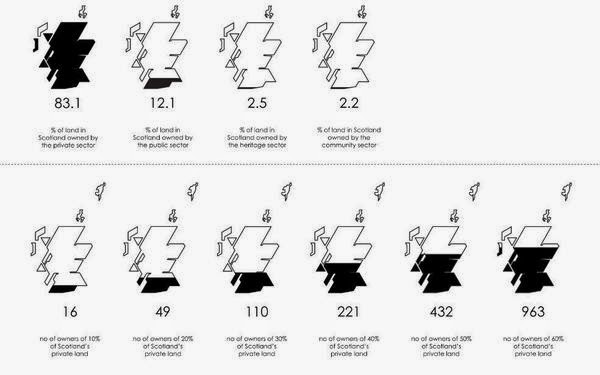
6. Fewer than 1000 individuals own 60% of all the land in Scotland. This represents a small number of very large estates, managed, generally speaking, with no thought whatever to the common weal.


7. When we consider large private land-holdings in Scotland which are arguably in the public interest, Grangemouth petrochemical works is the largest at some 700 hectares in total extent. Edinburgh and Glasgow airports are each smaller. Clearly, both the Grangemouth works and our large airports are significantly profitable and could bear a burden of taxation without endangering their viability.

Birthright: land area per head

8. Scotland has a land area of 78,000 square kilometres and a population of five million, which equates to 67 people per square kilometre or one and a half hectares per person. In natural justice it seems hard to assert that one person has more right to the enjoyment of the land than any other. Yet Richard Walter John Montagu Douglas Scott1 monopolises 111,369 hectares, arrogates the birthright of 74,000 Scots. The landed lobby complain that redistribution of land would be 'theft' which, they claim, would violate their 'right to property'. But the theft has already taken place, and time does not give good title to the proceeds of crime. However, as I shall argue below, redistribution can be achieved not by confiscation nor by compulsory purchase, but by the simple processes of ordinary taxation. Land which the owners voluntarily vacate because the burden of taxation is too onerous is not stolen, it is given up – or, to speak more honestly, returned to its rightful state.

9. In any case, however redistribution is achieved, achieved it must be. As this  graph shows, 1% of the population own more property by value than the other 99% put together. A community built on such gross inequity cannot stand.

10. I am grateful for the Land Reform Review Group's proposal for a fixed upper limit on private land holdings. If we were to take, as an example, an upper limit of 1,000 hectares – four square miles – and limit each of the big estates to this, we would release enough land to create quarter of a million new crofts.
Ilk' pauper pays their Vee Aye Tee
On aa they need tae live or dee
Fae whilk the lairds aa dip their fee
Their 'agriculture subsidy'
On land they lang syne stole fae ye
Land that they haud, whit's mair, scott free
Sall we bide douce, an let this be?
It's time tae rise as levellers again
11. However, I feel that very large holdings are best dealt with by fiscal means. If landowners are required to sell or surrender lands exceeding a fixed maximum area, I fear we might be bogged down in long running, complex and expensive litigation. Consequently I propose a tax, possibly in addition to a land value tax, payable on all private holdings of land but which scales exponentially with the total area of all holdings with common beneficial ownership.

The exponential land tax

12. The core of the idea is that a landowner pays a small amount on their first hectare of land, a little bit more on their next hectare, a little bit more on their next, and so on. There are two key numbers in this idea: the constant, c, which is the amount of money you pay on the first hectare, and the exponent, e, which is the power the number of hectares we've counted so far is raised to to calculate the little bit more. So what is due in tax per annum is Σ1..n(cn)e, where n is the number of hectares owned.

13. For example, with a constant of 40 pence and an exponent of 1.07, you get this pattern:


Holding

Annual tax liability

Average croft:

£4.03

Average farm:

£ 2,527.60

Glasgow Airport:

£ 24,231.17

Edinburgh Airport:

£ 43,991.94

Grangemouth Refinery:

£ 140,263.37

Thousand hectares:

£ 293,619.00

Ten thousand hectares:

£ 34,529,389.03

Countess of Sutherland:

£ 408,831,245.15

Duke of Westminster:

£ 1,133,132,260.20

Duke of Atholl:

£ 1,346,812,248.20

Duke of Buccleuch:

£ 4,849,562,627.23

14. As you can see from the table, based on these values for c and e, the tax due on the Grangemouth petrochemical works, or on the airport, would not be not onerous as a proportion of the business revenue. The tax on the Duke of Buccleuch would be unsustainable, even for him. Yet this is the same tax, levied under the same simple rules, on each holding.

15. As a detail to this, the exponential tax might possibly be levied only on land that was heritable; that is to say, a landowner, being a natural person, might elect not to pay the exponential tax. The rationale for this is that it is not really the ownership of land which causes the greatest social cost: it is the locking in of ownership to particular privileged families, persisting through time.

16. Under this revised proposal, if the landowner1 did elect not to pay the exponential tax, then on his or her death the land would revert to common; they would have, in effect, a liferent only. Or an owner being a natural person might elect to pay the exponential tax only on a specified portion of their holding, in which case that portion would be heritable and the remainder would revert to common on their death.

17. Obviously an entity not being a natural person could not elect not to pay the exponential tax as such entities do not have limited natural lifespans; obviously also, a landowner, being a natural person, who had elected for a period not to pay the tax could not start paying the tax and immediately regain the benefit of heritability.

18. This proposal does not mean turning distressed gentlefolk out of their castles and their mansions to wander destitute upon the highroad; on the contrary, it leaves them with amounts of wealth which are to their fellow citizens unimaginable. But it does mean that within one generation, fully half the land of Scotland would revert to common, available to local communities to employ as they see fit for the common benefit of the land, the community and its people.

House prices and the local economy

19. Much has been made of the depopulation and social disruption that has afflicted the 'crofting areas' - the Highlands and Islands. I do not wish to minimise that in the least. But depopulation and social disruption has affected areas of Galloway on an equally devastating scale. My home village of Auchencairn had, in the 1880 census, around 2400 inhabitants; it now has 180. That raw figure sounds devastating, and it is; but the truth is worse.

20. Of the eighty or so stone built houses which make up the core of the village, only two are now occupied by people born in the village, and those people are in their eighties. No more than six houses on Main Street are occupied by people of working age. There's a reason for that. The price of even a modest house is now of the order of two hundred thousand pounds, and local wages are depressed: the average working wage in the region is £20,800. So it simply isn't possible for people earning their living in the local economy to buy a house.

21. The reason for this is that people retiring from the cities, with the proceeds of selling an urban house, can outbid local people, and have done so. Most of these people are resident - only about 10% of houses stand empty - and many of them make a positive contribution to the community. But nevertheless their interests are different from the interests of people who need to earn a living in the local economy, and that does skew communal decision making away from economic development.

22. Furthermore, with the local private housing monopolised by incomers, what 'native' - second or third generation, or more - villagers remain are corralled into a bantustan of 'social housing' on the other side of the burn, leading to a community divided between white settlers in the increasingly gentrified village and natives in the social housing. This is not a good thing.

23. And finally, it's even worse than that. The people of my generation born in the village who remain in the village are the children of farmers who inherited the family farm, and those families which have subsisted largely on social benefits, and who therefore qualify for social housing. There's virtually no-one in between. Everyone else went away to university and never came back. There are no jobs for them, and there is no housing they can afford.

24. I'm painting a bleak picture. Driving through, you'd see a pretty village, and a vibrant village, with its own newly built, community owned post office, with its recently renovated village hall, with its new community allotments, with its generally well kept and pretty houses. It's true that, by comparison with many other villages in Galloway, Auchencairn is doing well. Nevertheless, my picture is also a true one, and it is a picture of depopulation and social disruption every bit as bad as that experienced in the West Highlands. It's just less visible.

25. Auchencairn, of course, is by no means unique. In villages throughout remote rural Scotland this pattern is repeated. A second clearance is being perpetrated; local people with real knowledge of and investment in the locality and its landscape are being progressively driven out, to be replaced by a population of incomers who, because of their age when they arrive, are active and effective members of the community for only a few years before being replaced in their turn with new strangers. These are not social conditions in which community can be sustained.

Second homes and hutting

26. As stated above, Auchencairn does not have a particular problem with second homes, but we all know areas of Scotland that do. The problem of second homes can be even worse for fragile communities than the problem of retirees, since their owners do not have time to put energy into community projects, and buy most or all of their needs in urban centres, where prices are lower.

27. Three strategies could address the second home issue. Firstly, there could be a formal change of use required to convert a dwelling house into a second home. Secondly, there could be sharply increased taxation on dwelling houses left unoccupied for more than 180 days (or some other defined period) of the year. Thirdly, in conjunction with a policy to promote and greatly increase hutting, use of dwelling houses as second homes could simply be banned.

28. A significant promotion of hutting would have the additional benefit that it would make regular access to the countryside and the land available for city dwellers in all income groups, not only the rich.

29. As an ironic footnote to this, Auchencairn did have, from the end of the First World War into the present decade, a colony of huts at Rascarrel, enjoyed by families primarily from Dumfries. They have, however, all been evicted by a landowner eager to make better profits from holiday chalets.

Related issues

30. Land is a core issue, one which cannot easily be separated out from a number of other issues which the Scottish nation must address urgently. These critically include:

  • Taxation
  • Local governance, and the powers and competences of local authorities
  • Planning and housing
  • Agriculture, fisheries and forestry
  • Energy
While these issues are outside the narrow scope of this particular consultation, I shall need to make reference to them in some of my responses.

31. I endorse and commend to you the submission of the Birnam Workshop.

The Consultation Questions

Q. 4. Do you agree that a Scottish Land Reform Commission would help ensure Scotland continues to make progress on land reform and has the ability to respond to emergent issues?

32. Land Reform will need to be a continuous process in Scotland for at least the foreseeable future, and the Government will need some body to oversee this process and to develop policy.

Q. 6. Do you have any thoughts on the structure, type or remit of any Scottish Land Reform Commission?

33. The Scottish Land Commission will be a prime target for elite capture. The rural 'great and good' – the great landowners and their agents and toadies – are bound to seek places on it, and it must be jealously guarded against them. A personal interest in private ownership of land should be a clear disqualification from appointment to such a commission.

Q. 7. Do you agree that restricting the type of legal entities that can, in future, take ownership or a long lease over land in Scotland would help improve the transparency and accountability of land ownership in Scotland?

34. Transparency of beneficial ownership is vital. It's (obviously) vital to any scheme of tax which is progressive with respect to the area held. It's also vital to communities seeking to discover who they have to negotiate with in order to achieve some change in local land management. However, such a change must affect current owners as much as incoming owners.

35. Where it cannot be shown who the beneficial owners of land are, for the purposes of a progressive tax all such land must be taxed as though it comprised one estate belonging to one beneficial owner, because it cannot be shown that this is not so. Under progressive tax this will automatically produce a very much higher tax burden on land whose ownership is obfuscated5, strongly motivating owners to deobfuscate ownership.

Q. 8. Do you agree that in future land should only be owned (or a long lease taken over land) by individuals or by a legal entity formed in accordance with the law of a Member State of the EU?

36. If it is the case that the beneficial ownership of every legal entity registered in the EU is a matter of public record, then this condition would satisfy my concern for transparency of ownership.

Q. 9. What do you think the advantages or disadvantages of any restriction would be?

37. I can see no disadvantages whatever.

Q. 10. How should any restriction operate and be enforced, and what consequences might follow if the restriction is breached?
38. There should be some specified and limited time period – perhaps six months – between the date the State notifies the registered owner of irregularities in their registration, and the forfeiture of title in the land. If the irregularities were corrected within that period, the title would not be forfeit. Otherwise the land must revert to common. Once it has reverted to common, there should be no legal mechanism for the former owners to recover it, or to be compensated for its loss.

Q. 11. Do you agree that better co-ordination of information on land, its value and ownership would lead to better decision making for both the private and public sectors?

39. Clearly so.

Q. 12. Do you hold data you could share or is there any data you would wish to access?

40. Apart from my own holding, I do not hold any. I certainly wish to be able to access data about landholdings in the Stewartry in particular, and across Scotland in general.

Q. 13. What do you think the advantages or disadvantages of wider and more flexible sharing of land information would be and do you have any recommendations about how this can best be achieved?

41. I think that a combination of crowd-sourcing based on (for example) the field boundary dataset, in concert with a public web API which allowed links to be made to official records, would enable the state to make use of local knowledge through citizen activism. Clearly crowd sourced knowledge could not be treated as authoritative in itself, but would form a basis for a much richer dataset than could be provided from official sources alone.

42. Ideally the data model would be sufficiently open to support mapping of such things as biodiversity, land management, climate record, public access and other forms of information as well as ownership and planning designation.

43. The Open Street Map and Geograph projects provide models of how crowd-sourcing might work.

Q. 14. Do you agree that there should be powers given to Scottish Ministers or another public body to direct private landowners to take action to overcome barriers to sustainable development in an area?

44. It is extremely tendentious to claim that 'Landowners are instrumental in promoting sustainable local development and supporting communities.' In most areas the opposite is the case.

45. In general and with a very few honourable exceptions, large private landowners are by their very existence barriers to sustainable development.

46. The appropriate level of public authority to intervene is not in the first instance ministers. Land issues are local issues, and it is communities who should be empowered to intervene and direct. Clearly, mechanisms must be put in place to resolve disputes between communities and landowners, but the presumption must be that community interest should always takes precedence over private interest.

Q. 17. Do you agree that public sector bodies, such as Forestry Commission Scotland, should be able to engage in a wider range of management activities in order to promote a more integrated range of social, economic and environmental outcomes?

47. Generally I think Forestry Commission land should be released as common and passed into the care of local communities, as local communities gain the self confidence to wish to take this on. As a founder trustee of Southwest Community Woodlands Trust I appreciate both the need for very long term management and stewardship of woodland and the need for a strategic timber resource; consequently I understand the need for communities to continue to be supported by expert advice and assistance from public service foresters. However it does not seem to me that there is any need either for the ownership of the land to be centralised, or for the final authority for management decisions to be outside the local community.

Q. 20. Do you think a trustee of a charity should be required to engage with the local community before taking a decision on the management, use or transfer of land under the charity's control?

48. I have very grave doubts as to whether there is any 'charitable purpose' whatever in owning land, with the possible exception of conserving ancient monuments. Obviously charities may need to own land to provide for their offices, and some types of charity may need to own land for other buildings. But where environmental charities are concerned, it seems to me greatly better that the land should be common and should be managed by the community as common, with the charity providing advice and incentives to influence that management in the direction that it would prefer.

Q. 21. What do you think the advantages or disadvantages would be?

49. So long as charities own and manage land, they will continue to do so to the detriment of the community and of the public interest.

Q. 22. How should "community" be defined?

50. Community councils are much maligned. But we have a clear concept of a community council area, normally based on a settlement or a subdivision of a settlement and its surrounding lands. It seems to me that for the purposes of a legislative framework, the collectivity of people normally resident in such an area, possibly considered together with those people with strong associations with the area not currently resident, provide as good a proxy for community as we're likely to get.

51. Under present legislative arrangements, the community council is effectively the collective voice of such a community. As community councils are given more competences and more discretionary budget, elections will become better contested and the quality of people elected will tend to improve. Although there will always and inevitably be some community councils which are not providing the best possible community leadership and service, democratic organisation is always to be preferred to a quangocracy of the unelected sio-disant great and good.

52. Under the principle of subsidiarity, community councils are generally the appropriate tier of government to consider detailed local land issues.

53. It's worth bearing in mind that in many rural areas there are people with strong and long-standing associations with a locality who are not normally resident. These people include, for example, people of local descent who have moved away for education or employment; hutters and others with a long-term relationship with the area as visitors, including the homeless, yacht owners, or caravanners; and, in some areas particularly, climbers and other mountain sports enthusiasts, anglers, cyclists or canoe users. Some mechanism is needed to allow non-residents to register their long term commitment to and interest in a particular locality, and to have some influence over the community council, perhaps a vote in community council elections. But such non-resident registration would have to be limited – perhaps an individual might register such an interest with only one locality in addition to their place of normal residence – and should, I feel, involve some cost.

Q. 23. What remedies should be available should a trustee of a charity fail to engage appropriately with the local community?

54. I've said above I'm not persuaded there's a public interest in charities owning land. However, where a charity does own land (and I have been a trustee of a charity that does), if it acts against the expressed will of the local community then, if the dispute cannot be resolved, I think either the land should revert to common or the charitable status should be revoked.

Q. 24. Should the current business rate exemptions for shootings and deer forests be ended?

55. Second only to housing Trident missiles, sporting estates are the most obscene misuse of Scotland's land. While I believe a wholesale review of land taxation is urgent, in the interim business rates would be better than nothing. But they would represent a very small amount of revenue in respect of a great deal of territory whose current use is manifestly contrary to the public interest.

Q. 25. What do you think the advantages would be?

56. A very small benefit to the public purse.

Q. 26. What do you think the disadvantages would be?

57. It might be used as an excuse to delay the much needed general review of land taxation.

Q. 27. Do you agree that the need for court approval for disposals or changes of use of common good property, where this currently exists, should be removed?

58. No, I don't, quite the contrary. Local Authorities across Scotland are disposing of or building on common good land to make up for temporary shortfalls in their budgets, and this cannot continue. There should be extremely strong safeguards against further disposals or changes of use of common good land.

Q. 28. If removed, what should take the place of court approval?

59. A plebiscite of the local population might be an alternative, subject to a minimum turnout guard.

Q. 29. Should there be a new legal definition of common good?

60. I'm not qualified to comment on this.

Q. 30. What might any new legal definition of common good look like?

61. I'm not qualified to comment on this.

Q. 31. Do you have any other comments?

62. There is a distinction between common good land and common land. I would like to see a public policy commitment to having at least 50% of Scotland's land area common by 2050. I would like to see the total area of common good land also increasing rather than decreasing.

Q. 32. Do you agree that the Scottish Government should take forward some of the recommendations of the Agricultural Holdings Legislation Review Group within the proposed Land Reform Bill?

63. Scotland's tenant farmers are among the most exploited and oppressed groups in western Europe. Such legal protections as they have are minimal, and many live in unfit habitations under constant insecurity and bullying. Tenant farms are very often marginally profitable, with virtually all the surplus being gouged by the landowner. We hear regularly of tenant farmers being sanctioned when they make any public protest against their conditions.

64. Under these circumstances it is ridiculous to suppose that tenant farmers, unsupported, could make adequate representations to parliament to make their voice heard, against the extremely well funded public relations and lobbying machine that is Scottish Land and Estates.

65. It is vital in order to protect the interests of tenant farmers that reforms of such protections as they have are passed within the body of the Land Reform bill, in order that they may have the support of a wider activist body.

Q. 35. Do you agree that further deer management regulation measures should be introduced to be available in the event that the present arrangements are assessed as not protecting the public interest?

66. I'm not aware of anywhere in Scotland where the present arrangements adequately protect the public interest.

67. The issue of the overpopulation of grazing and browsing animals on Scotland's uplands needs to be addressed urgently and seriously, since erosion of topsoil is happening at an unsustainable rate and problems of storm water runoff are greatly aggravated by the lack of forest cover. Flooding and landslips have become pervasive problems in many parts of Scotland at huge cost to the public purse, while open scree is growing in many areas leading to instability of hillsides.

68. It needs to be remembered that the 'natural' state of almost all of Scotland is forest. There are productive forests in Norway at higher altitude than the peak of Ben Nevis. While heather is a native species, large open heather moorlands are not natural. They are man-made wet deserts, with extremely impoverished ecosytems. Where grazing pressure is taken off, at all altitudes at least scrub and in most places forest will make a natural recovery.

69. The problem is not only deer. Grouse also contribute, as do sheep, and in some areas wild goats. There are sustainable levels of population for all of these species; all are present at sustainable levels in Scandinavian boreal forests, as are elk, a species once native to Scotland. However, without climax predators there is no natural mechanism here for maintaining sustainable populations.

70. We should reintroduce Scotland's native climax predators: lynx and wolf most urgently.

71. While predator populations are re-establishing, either landowners must be required to cull browsing and grazing species to levels at which forest cover can regenerate, or else the State must intervene directly and cull.

Q. 36. What do you think the advantages would be?

72. People would be able to drive over the Rest and be Thankful in winter. The burghers of Elgin would not be flooded out of their homes. Tourism would increase.

Q. 37. What do you think the disadvantages would be?

73. None.

Q. 38. At present, section 18 of the Land Reform (Scotland) 2003 Act is silent on the issue of resolving objections to a core path plan consultation. Do you agree that access authorities should be required, in the interests of transparency, to conduct a further limited consultation about proposed changes arising from objections?

74. The Land Reform Act 2003, where enforced, is an admirable piece of legislation which has been of great benefit to everyone in Scotland. However, the problem is that it has not been sufficiently enforced, and some landowners still seek to dissuade or restrict access to their land, and public bodies do not do enough to enforce access rights.

75. The behaviour of the Loch Lomond National Park Authority in this regard is particularly disappointing.

Q. 39. Do you agree that section 20 of the 2003 Act should be clarified so that Ministerial direction is not required when an access authority initiates a core path plan review?

76. I agree that section 20 of the 2003 Act should be clarified so that Ministerial direction is not required when an access authority initiates a core path plan review. Once again, land issues are local issues. The appropriate level of public authority to act  is the community council, or, for longer distance paths, the local authority.

Q. 40. Do you think that the process for a minor amendment to core path plan (as set out in section 20 of the 2003 Act) should be simplified to make it less onerous than that for a full review of a core path plan?

77. This seems sensible.

Summary

We Scots were ae a motley band
Cam fae ilk airt intil this strand
But Scotland. noo, is whaur we'll stand.
Sall 'indy' be oor sole demand
While six hunner haud half the land
An aa the siller in their haund?
Aye right. That's no whit we hae planned!
It's time tae rise, it's time tae rise, it's time tae rise, it's time tae rise
We're here tae rise as levellers again!
78. It is not acceptable in the twenty-first century that we should perpetuate inherited privilege through land-holding. It cannot be acceptable that changes in the management of land are made without the consent and involvement of the people of the locality. Land cannot, ultimately, be allowed to be a private resource. It belongs, inalienably, to everyone or to no-one.

79. If we are to create a Scotland where every person is equal, a socially just Scotland that is at peace with itself and can hold its head up among the community of nations, then everyone must have equal access to the land.

Creative Commons Licence
The fool on the hill by Simon Brooke is licensed under a Creative Commons Attribution-ShareAlike 3.0 Unported License