Showing posts with label Rural policy. Show all posts

Friday, 24 July 2020

Rape, grouse, and the pathology of power

Red Grouse
Red Grouse (source)
I got into a foolish Twitter dispute last night, and ended up saying something I fundamentally think to be true. People will say, and with good reason, 'oh, Simon's gone off on one again. He's mad, you know'. And, of course, it's true. I am insane. A really frustrating consequence of that is that sometimes my judgement is seriously wonky. But it also means I can say thing that other people are too sensible to say. Let's explore this idea.

Firstly, to roll back a little, I do not believe that anyone is irredeemable. 'Evil' is not a word that should be applied to people. And, I believe, usually, people who do evil things do so because evil has been done to them.

So this is an essay about the pathologies of power.

I want to examine a number of things:
  1. The Bulingdon Club, and Alpha Epsilon Pi
  2. Grouse moors
  3. Jeffrey Epstein, and child sex abuse
I will argue that these are on the same spectrum.

To demonstrate huge wealth is not difficult. One merely has to drive a gold plated Lamborghini. To have power, one has to be able to use it. One has to be able to do things which other people, people with less power, cannot do. And one has to be able to do these things with impunity. To show to others that one has power, one has to actually do things which other people cannot do: one has to use power performatively. And, indeed, this is the only way one can answer the question, 'how much power do I have?'

The Bullingdon Club is a club for very rich young men at Oxford University, it has been in existence for more than two hundred years, and with very much its present reputation for at least one hundred years. The reputation of the club is for extremely bad behaviour, with records of extreme destruction of other people's property from as early as 1894 to as recently as 2010.

Apart from wrecking country houses and restaurants, notorious Bullingdon practices include

1. Forcibly removing the trousers of members of the public;
2. Burning £50 notes in front of homeless people;
3. Bestial necrophilia.

Alpha Epsilon Pi is not quite as elite as the Bullingdon Club. It is a 'fraternity' of university students at a number of universities, originally in the US, but including, specifically, St Andrews in Scotland. The chapter at St Andrews in particular has been associated with a startling number of allegations of rape. (Dani Garavelli wrote a very good piece which refers to the Alpha Epsilon Pi allegations in Scotland on Sunday this week)

All just young men's high spirits, don't you know? Or a systematic way for rich young men to explore just exactly how much bad behaviour they can get away with?

Very well. Let us move on to child sexual abuse and the sexual exploitation of very young women; and the very large number of allegations around it which centre on rich and powerful men.

Not all allegations of child sexual abuse are associated with powerful people, of course; that's not what I'm arguing. What I'm arguing is that the pathology of power draws people to explore what they can get away with. Child sexual abuse is the crime which in our modern society is most reviled and most stigmatised (and with reason). If you want to demonstrate that you can get away with anything, this is the Everest, the pinnacle.

What I'm arguing here is that the attraction of child sexual abuse to very powerful people is not (at least mainly) an erotic attraction to very young bodies, just as the alleged sexual act between a former prime minister of the United Kingdom and a dead pig was not primarily about the erotic attraction of pork. On the contrary, both are, at least in part, a pathological need to explore the limits of power.

Corpses of grouse, pheasants and geese left to rot in a pit on a shooting estate.
Corpses of grouse, pheasants and geese
left to rot (source)
Which brings us on to grouse moors. Grouse moors represent the environmental destruction of large areas of countryside in order to provide an opportunity for a very few people to slaughter a large number of birds - birds which are not particularly good eating and which are in fact largely dumped and left to rot for this very reason.

The grouse, like the child sexual abuse victims and the dead pigs, are not being shot for their intrinsic value; they're being shot for their trophy value: to prove that the shooters can get away with it.

So what is it they're 'getting away with'? Shooting a few wild birds does not seem so shocking, surely? Well, no. But in order to create the environment in which birds can be shot in such numbers, hundreds of people must be driven out of their homes and off their ancestral lands.

Enclosing commons was how the powerful of the seventeenth and eighteenth centuries demonstrated their power. They had the power to drive the common people out of their homes and off their land, and they did. Having enclosed the commons, of course, they could then farm the most productive parts more intensively (or at least, rent them out to farmers, who would do so, at high rents) and make profits.

But a large part of the lands from which they had driven the subsistence farmers could not be farmed profitably in any other way, so what to do with it? The answer was to create vast deserts on which to slaughter small birds.

Just as, as feminists keep saying, rape is not (mainly) about sex, so enclosing the uplands is not mainly about improving agriculture - the new 'improved' agriculture could make no use of such marginal land. What had been, from April to September, the summer shieling of tens or hundreds of thousands of subsistence farmers, became an arena, for a few days in August, to display the power of the few.

Solitudinem faciunt, bona appellant.

Birds of prey - especially large birds of prey - are the most visible of the iconic species of our wildlife. Wildlife is not the 'property' of anyone: rather it is a commons for us all. Birds of prey eat meat. Not huge amounts of it, but it is what they eat. I find the idea that eagles or red kites significantly predate on red grouse improbable. Hen harriers, of course, will do so, where grouse are abundant.

There is a certain bitter rationality to gamekeepers slaughtering hen harriers, wild cats, foxes and stoats on grouse moors: the gamekeepers are paid to provide plentiful easy targets for their employers to take aim at. Predators which predate on ground nesting birds will necessarily reduce that plenty. This is how ecosystems work, after all.

Mountain hares killed on a single day on
a single estate in the Angus glens (source)
But the fact that eagles, kites, pine martens and mountain hares are also slaughtered indiscriminately on grouse moors is evidence that this isn't about bitter rationality, or any rationality at all.

The fact that ordinary people - people who are not powerful - take pleasure in seeing eagles, kites, hen harriers, ravens, wild cats, foxes, stoats and mountain hares - mountain hares! - is the only reason to exterminate them. It's a naked demonstration of power over the commons. Power to steal, to desecrate, to destroy, and to do so with impunity. Wanton and blatant destruction of common goods. Bad behaviour performed solely for the purpose of showing that you can get away with bad behaviour. And this, I claim, is evil.

Wherever you find rich and powerful people wishing to demonstrate their wealth and power, you'll find others who make their living by enabling it. The Oort cloud of lawyers and estate agents who orbit Londongrad are an example.

So Ghislaine Maxwell was, in effect, Epstein's grouse moor manager. She organised the provision of plentiful easy targets for him and his friends to take aim at, and managed the arenas in which they bagged their trophies.

What I'm arguing here is not that grouse moors are 'as bad as' child sexual abuse - clearly, in terms of direct harm to specific individual people, they are not.

But I am arguing they are on the same spectrum, driven by the same pathology.

And the reason that this matters - the reason that I believe we should look on the owners of grouse moors with the same eyes as we look on those people in the other categories I've discussed - is that it people have a propensity for performatively extremely bad behaviour in one aspect of their lives, it is highly probable that they are exhibiting equally unacceptable behaviour in others.

Wednesday, 14 August 2019

Eagles, and governance

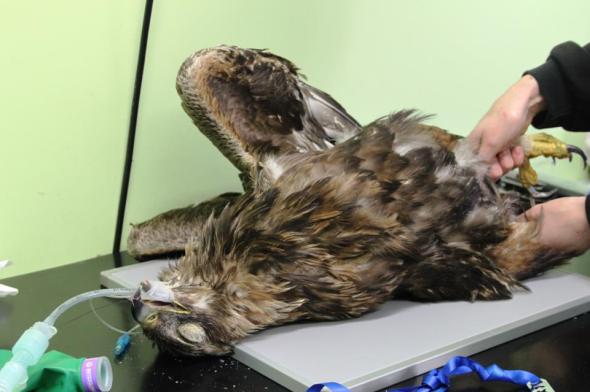
Young eagle flying with trap clamped to its leg
Here is the text of my letter to the First Minister regarding the wildlife persecution on grouse moors crisis. I strongly suggest you write to her too, but please write your own letter - copy/pasted letters tend to get ignored.
Dear First Minister

The SNP's craven inability to face down landed interests has always disappointed and puzzled me, but the developing crisis over the behaviour of grouse moor managers and the failure of your government to intervene in it is reaching the stage where it risks undermining the whole independence project.

You will (I hope) be aware of the illegal slaughter of Scotland's iconic wildlife on the grouse moors, from eagles to wildcats. You will (I hope) be aware that there is today a young eagle flying in Aberdeenshire with an illegal trap clamped to its leg.

Now, we have a petition, addressed to the Westminster parliament, asking it to intervene in a devolved matter. which in less than one day has gathered more than 16,000 signatures, and which is highly likely to gather several hundred thousand. You will see from the map that a very large proportion of these signatures have come from remote rural Scotland - where you cannot afford to lose votes.

In these febrile times, do you really want Westminster holding a debate on the failure of your goverment? Do you want grandstanding Tory ministers - the fragrant Alister Jack - having a popular excuse to take powers back from Holyrood because of Holyrood's failure to legislate effectively?

We have left an open goal, and in the run up to the next trial of strength on independence we do not want the Unionists to be able to say, "well, we trusted them to care for their own woldlife but they wouldn't do it; why should they be trusted with independence?"

It's a good question, and one which will be hard to deal with on the doorsteps.

Please act now, by enacting a bill which places a duty of care on estate owners to prevent wildlife crime on their land, with penal sentences on the beneficial owner if they fail to do so.

Yours sincerely

Saturday, 27 October 2018

The Standingstone Model

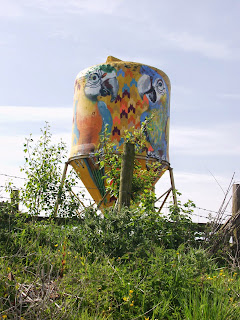
The old feed store, with Alice's parrots.
All photographs in this post are from
 Standingstone.
It's no secret that I live at Standingstone. In fact, if you check at Companies House, you'll see that I am the chair of Standingstone Farm Limited. So what is Standingstone?

Standingstone is a conspiracy.

It wasn't set set up to be a model of how you solve the problem of rural depopulation, and, indeed, it doesn't, in itself, serve as a model to solve the problem of rural depopulation. But it serves as a seed from which the shape of a model can be discerned.

Standingstone is a conspiracy of homeless people to house themselves; to house themselves by buying a farm. It isn't - it couldn't be - a conspiracy of just any homeless people. To join the conspiracy, you had to be
  • Local to Auchencairn village;
  • Unable to afford to buy a house locally;
  • Unable to access social housing locally;
  • Able to afford the minimum buy-in to the project, which was £30,000, so not trivial;
  • Willing to agree the principles of sharing with the rest of the group;
  • Unconcerned by the fact that we would not have and were unlikely to get planning permission for the homes we needed.
In other words, you needed to be to some degree a scofflaw, and to have access to at least some capital.

There were some people who were otherwise qualified to join the conspiracy who couldn't reach agreement with the rest of us over sharing; there were some people who we'd really have liked to have here who couldn't raise the buy in price. Those people are not here. That may sound ruthless, but it is what we could pragmatically achieve.

It's consequently a very select group. We were also lucky that left-wing local farmers were prepared not only to offer us the farm, but to wait almost a year while we built and negotiated a group that was able to raise the price (in the end we bought only eighty-eight acres of the one hundred and twenty we were originally offered, because that's all we could afford).

But the number of people normally resident on the farm is about twenty-five, in eight households; and there's a much larger penumbra of people who are associated with the farm, who are often in practice resident. That's an increase of more than 1000% on the two people who lived here before we bought it. It wasn't set up to reverse rural depopulation, but it has the effect of holding people in the area who would otherwise have been forced to leave. And, the farm is home to more than 10% of the children in the local school. In that sense, we're actively reversing depopulation.

We operate as a sort of hybrid between a co-op and a conventional company. Each household that bought in bought a croft (originally eight crofts, now seven). The crofts vary in size between five and twelve acres, depending on how much money was put in. But each croft, regardless of size, regadless of money invested and regardless of how many people live on it, has two votes.

We own most of the woodlands, some of the pasture, and all of the agricultural buildings which were on site at the time we bought the farm, in common.

None of these crofts provides a full household income, although two provide substantially all of the household's food with a surplus to sell. But we none of use depend on our crofts for the whole of our income; we are variously software engineers, artists, musicians, tree surgeons, joiners, nurses, blacksmiths, electricians.

One household occupy the farmhouse; they had enough income to be able to raise a mortgage. The rest of us occupy old caravans, old horseboxes, a yurt and a hut. That's changing. One household has built a magnificent barn, while another household is currently building a real house with real planning permission. Both of these buildings have been built largely with sweat rather than money - the timber for both arrived on site as logs and has been sawn here. But they're both valuable.

This represents something that needs to be learned; a weakness in our model which should not be reproduced. When we negotiated the original settlement, the deal was that the company (that's all of us) had first option to buy any croft that was sold, at a price which more or less represented the purchase price of the croft. If either of these crofts were to be sold, it would be unjust for the company to say 'we can buy this croft for the original purchase price'; but it would be simply impossible for the company to buy the croft at a price which recognised the value of the buildings. If the crofts with these buildings are sold on the open market, it will be impossible for households in housing stress to buy them - they'll be by far too valuable, and consequently they'll sell to people from outside the local economy who have wealth unavailable to people in the local economy. So while we've largely solved the problem of housing stress for us in our generation, ultimately we may just be creating buildings which will become part of the problem.


The problem
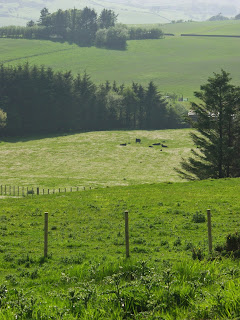
View over the commons
Many remote rural areas of Scotland, especially in areas of good scenery, are now characterised by house prices which are significantly higher than the local economy will support. This means that people who have jobs in the local economy can't afford housing, and that the housing that is available sucks in people whose wealth and/or income derives from outside the local economy.

While there was at one stage a lot of optimistic prediction that the internet would bring high value work to rural areas, this hasn't really materialised. There are a number of reasons for this; one is that it is and will for the foreseeable future be cheaper to deliver high bandwidth connections in urban areas; and another is that knowledge work generally is teamwork, and teamwork does not really work as well without the constant informal interactions of proximity. This isn't to say that improved digital communications can never bring higher value jobs to rural areas, but they haven't yet.

At the same time the population of rural areas has declined steeply over the past century to the point where population densities are in many places too low to support local services. In my lifetime, Auchencairn had a soutar (cobbler), a bakery, a post office, a pub, three shops, a garage, a school, a church, a police station. Even that was a sharp decline from fifty years previously. Now, one shop, incorporating the post office, remains but its future is uncertain; the garage remains, but its future is also uncertain; the school and church remain. The rest are gone. Part of the problem is the steady increase in holding size and the steady decrease in the number of people actually engaged with the land.

There are also strong factors militating against adding value to produce in the rural economy. The creamery at Kirkcudbright has gone; milk from the Stewartry is now trucked either to Lockerbie or to creameries in the central belt. A few small producers are successfully maintaining local production: Loch Arthur's cheese production, and Cream of Galloway's ice-cream and now cheese, are leveraging good produce to provide additional jobs on the farm.

Other businesses in small towns such as Castle MacLellan Foods and West Coast Sea Products add value to produce locally and retain jobs in the local economy, but these are neither strictly rural jobs nor are they high value.

Furthermore, a bureaucratic food standards regime makes life extremely hard for small food processing businesses, as the current problems at Errington's Cheese illustrate. It seems both that Food Standards Scotland are prejudiced against unpasteurised products, and that they greatly prefer large industrial production units which are easier for them to inspect. Following the Errington's debacle, it's going to be extremely hard to raise capital for new small rural food businesses.

Agriculture does generate some high value work, of course. Agriculture uses increasing amounts of capital equipment, which must be developed, designed and manufactured somewhere. In Castle Douglas, Auchencairn's local market town, the milking machine was invented; the first milking machines in the world were designed and developed here. The company which made those first milking machines still exists; I buy plumbing parts, baler twine and tractor accessories there. But it no longer makes anything. The design and manufacture has long since gone to distant factories in distant cities, and none of the wealth generated comes back.

With the lack of high value employment locally, it's inevitable that many of the people buying the housing are past employment age: people retiring from much higher paying urban economies, selling a perhaps modest house or flat in the city to buy a retirement home in a pretty village; or perhaps people in their middle years, using wealth inherited from their parents to buy a good, solid house which will stand empty for ten months of the year.

The holiday home owners are utterly parasitic on the rural economy. Typically they buy their groceries in urban supermarkets; they have their vehicles maintained in urban garages. The only local services they buy are building and garden maintenance, and those sporadically. They contribute nothing to local civic society.

Retired folk are somewhat better. They arrive at about sixty-five; for ten years they energetically involve themselves in local activities, and during that period learn something about the locality. They buy their groceries locally, service their car locally, get their hair cut locally, use health-care services locally. For ten years, they contribute. Then, at around seventy-five they become infirm. Even then they're not entirely parasitic: they're increasingly providing employment for health and care workers - but their care is being paid for out of a local budget to which they did not contribute during their earning years. At around eighty-five they die, and are replaced by a fresh wave of energetic sixty-five year olds arriving from the cities.

But there is one significant problem with retired folk. They want the landscape of their idyll unchanged the way it's always been - by which they mean how it was ten years ago when they first saw it. They're extremely resistant to changes that could bring jobs and wealth into the community, and they're completely unaware of what the local landscape looked like just twenty years before.

You cannot build or maintain a community on the basis of a rolling population of elderly strangers, no matter how talented, well meaning and energetic. Furthermore, a population of elderly incomers provides no children to keep local schools open. Finally, of course, in a community where all the decent housing has been bought up at high prices, there is nowhere locally for the care and health workers needed to service this elderly population to live.


The shape of the solution

A family with four children under twelve live here
To achieve a population density to maintain local services, we need to be able to provide desirable homes for people of working age, with children, at a price that work available in the local economy can fund.

Why can't we?

In a capitalist market, the price of a good (in this case shelter) is the price which some person is prepared to pay for it. It doesn't have to be the person who needs the good; thus throughout the Irish potato famine, when a million people in Ireland starved to death, Ireland was exporting record amounts of food. Similarly in the Ethiopian famine of 1984, Ethiopia was generating foreign exchange by exporting water melons to Europe. It wasn't that food wasn't available; it was that the food which was available wasn't affordable to local people, because wages in the local economy didn't generate enough money. So it is with housing in rural Scotland.

The factors which drive prices up are high demand, limited supply. Supply of rural housing in Scotland is largely limited by planning restrictions, imposed by relatively distant bureaucracies. In some places it's also limited by monopolist landowners, who refuse to release land for housing. High demand is generated by the steady supply of pensioners retiring from successful careers in the cities.

We need to produce housing - good housing, housing which people will aspire to - which is protected from the capitalist market, and reserved for people who work and raise children in the local economy. At the same time it is essential to ensure those people can have a good life. To lead a good life on the restricted income which is available in a remote rural economy, you have to be able to get the best out of living in a rural place. You need to have access to your own ground, where you can grow food to supplement your diet and even your income; you need access to your own woodlot, from which you can extract carbon-neutral fuel from domestic heating.

And you need access to neighbours - to community. To people with whom your can share your joys and celebrations, but also your major work projects; so that raising a house, or gathering in a harvest, can become a communal event, a shared event, a celebration in itself.


Adapting the model

As I've implied above, there are mistakes that I believe we've made in setting up Standingstone, mistakes which will militate against it being a sustainable place for people who earn their incomes in the local economy to live beyond our own generation. Our members will, gradually over time, build legal houses with planning permission, and those houses will represent sufficient wealth that, should they or their heirs choose to sell, the rest of us will be unable to afford to buy the croft in, and anyone buying on the open market will not be the sort of people we wanted this place to be.

So to take us uncritically as a model of how to build new rural communities does not work. But relatively little change would be needed to make the model sustainable.

Rural Housing Burden

I see two ways forward. The first would be to make all houses we build subject to the Rural Housing Burden. The Rural Housing Burden is a truly estimable scheme introduced by the Scottish Government, the terms of which are as follows
"The purpose of the Rural Housing Burden title is to maintain affordability on a property in the event of future sales. The plot the title is placed on has usually been acquired at well below the market value and the title ensures that the discount is included in the future sale price. The community have 42 days in which to accept the offer. 
"If the burden is not exercised, it will lie dormant until the next sale, so it remains in the title in perpetuity."
We could have made all houses we built subject to the Rural Housing Burden. We discussed it, but we didn't agree to it. I think this was a mistake. However, a future community could make this part of their ground rules.

Liferent

The alternative is that instead of selling crofts to its members, a future community would let liferents on crofts. A liferent is a traditional Scottish form of land tenure in which someone is given the usufruct of a piece of land for their lifetime. When the tenant died, the land would return to the landowner, which in this case would be the community. To adapt the liferent model to our needs now, the liferent would probably need to be given to a cohabiting household on an 'either or survivor' basis, so that if a member died, their surviving partner would still have security of tenure to the end of their life.

Of course, in modern conditions, cohabiting households do not necessarily cohabit for life. When cohabiting relationships break down, there would need to be some form of negotiation over who would continue the tenancy, but that is outside the scope of this essay.

The liferent model means, of course, that households can't build homes on their land as heritable property, and consequently probably can't get a mortgage to build a home. But the community, to which the land will return at the end of the liferent, could borrow long term against the security of the property, to finance building.

I'm promoting the liferent model rather than an ownership model because inheritance is the primary engine which drives social inequity. If we create heritable crofts, they too will ultimately become valuable and will confer unearned privilege on the children of crofters.

The liferent model doesn't, of course, mean that the former tenants children can't take over the tenancy after the death of their parents; it only means that the community as a whole gets to choose who the next tenant will be. Of course the children of the previous tenants could, if they wanted, be candidates. It's probable that many communities might have a presumption that children would take over their parents' croft. The only principle I'm trying to defend here is that it should not be automatic, should not be a right. I'd emphasise the liferent model especially if any degree of public money has gone into the intitial acquisition of land; crofters really shouldn't be able to profiteer on the back of public subsidy.

A liferent might entail a one off payment to the community at the start of the tenancy, or might entail an annual payment; that is I think a matter for the individual community.

Residency condition

Living in a rural economy is precarious. A croft does not, and will not, in itself provide a family income. Crofters and small farmers from across Scotland have had to work away from their land throughout history, to earn cash income; as mercenaries, as herring fishers, as whalers, as oil workers. I often have to work away as a software engineer. It isn't reasonable to place a condition on a crofting tenancy that the tenant must be permanently resident. At the same time it's clearly an abuse if you hold a tenancy but in practice use the croft as a holiday home, sublet it to someone else, or leave it vacant.

I think that after some period of non-residency - I would suggest five years - the community should be able to terminate the tenancy. That doesn't mean that the tenancy would automatically terminate, just that there would be a right for the community to terminate it, which would be a means of forcing the tenant to start a dialogue with the rest of the community about what they intended.

Obviously, it should also be possible for a tenant to voluntarily give up a tenancy.

The importance of commons
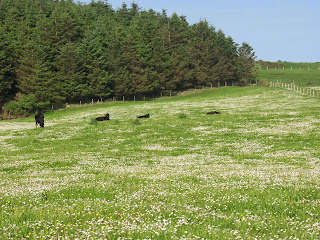
My cattle in Commons Meadow
When we set up Standingstone, our original view was that all the existing agricultural buildings, all the woods and part of the pasture should be common. It didn't work out like that; two crofts (including mine) ended up with small parcels of woodland. But the buildings, the largest wood, the access roads and one field have ended up as common and I think that has positive value. Common assets and common responsibilities provide something concrete to bind the community together; having common pasture means that there is a buffer of reserve grazing for when individual crofters have more beasts than their own grazing can carry, without dedicating that grazing to a particular croft permanently. We also, of course, have to discuss who will have use of it when.

One thing we don't currently have, and would undoubtedly benefit from, is the equivalent of a village hall - a communal meeting and events space, although to some extent The Void, our former high-slat cattle shed which we use as communal industrial space and store, could fulfill this function. The Void is a very significant communal asset; all the buildings we've built so far have been partially prefabricated in it, our tractors and vans are maintained in it, and each croft has a substantial area of storage in it.

Roughly 25% of all our land is common; I think that's a minimum. Three of our crofts are five acre, one (the most productive) seven acre, two ten acre and one twelve acre. I think that a five acre croft is pretty much a minimum; it will with work largely feed a family but it won't create a great deal of surplus.


Financing this

Land is cheaper when bought in larger parcels. A five hundred acre farm of good grazing/reasonable arable land is currently for sale locally for offers over a million pounds, which is to say about £2000 per acre. Such a farm would support about fifty households on five acre crofts with two hundred and fifty acres of common (or rather larger crofts with rather less common, for example seven and a half acre crofts with one hundred and twenty five acres of common). A single community of fifty households may be too big to work smoothly and it might be better to split a five hundred acre block into two communities each of twenty five households, but that's a detail.

The point is, the buy in price of a community on land at this price is twenty thousand pounds per croft. Twenty thousand pounds is less than the average annual wage in Galloway, and is thus not an impossible amount for many households to raise. So it's possible - with appropriate changes to planning law - to set up communities without public money.

However, that would buy just the land. At Standingstone, the planning authorities have in effect turned a blind eye to the fact that at present almost all of us are living ilegally, in structures which do not have and would not get planning permission. Most of us aspire to build legal housing, but speaking for myself it's unlikely that I will be able to afford to do so in my lifetime.

It's reasonable that the planning authorities should turn a blind eye, since they know that more than 5% of the adults normally resident in this parish live in illegal structures anyway, and we represent an attempt in the to long term address that problem. We also provide 10% of the children in the school. There's also a probable benefit to the authorities in that Standingstone concentrates most of the hippies and scofflaws of the parish into one place. But the most important factor in our favour is that, as long term local people, we have the support of the village and of our community council.

For privately financed communities to work, there needs to be some derrogation from planning law, either by formalising the 'blind eye' or by allowing a time window for legal structures to be built; there also, obviously, needs to be a presumption that planning consent will be given for a dwelling on a croft. However I think that such planning permission should be conditional on the Rural Housing Burden applying to any dwelling constructed.

The public interest in repopulating remote rural areas

We live in an economy which is governed primarily by and for urban areas. In this economy, remote rural areas are increasingly stressed. It actually does not serve the urban economy if remote rural areas become extensive ranches producing low-value commodity foods, interspersed by picturesque villages inhabited entirely by geriatrics. The rural areas then become a complex cost for the urban economy to bear. It's to the public good to have a self-sustaining population in remote rural areas.

What changes to public policy would be needed to support the creation of 'Standingstone model' crofting communities?

Changes to planning law

Two key changes are needed to planning law. The first is needed anyway, the second is desirable anyway but needed if no public money is to be made available to support the model.

Presumed consent to construct dwellings
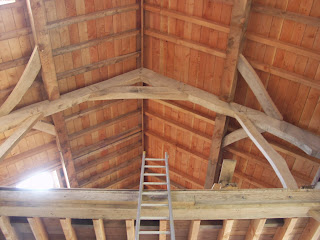
Interior of one of the buildings we've built
The first change is that there should be a presumption that consent will be given for a dwelling adequate to house a family to be constructed on each croft, and that that dwelling should be subject to the Rural Housing Burden. That's vital. If people can't legally construct dwellings in which they can then legally live, then the scheme is one which only scofflaws like ourselves will be able to take up.

Planning departments must also not put too onerous conditions on houses to be built. My neighbours James and Vicky, the first of us to get planning permission to construct a legal dwelling, had to spend ten thousand pounds on architects and engineers fees to satisfy the planning and building control authorities. That's more than a third of the total I estimate I could raise to build myself a more permanent dwelling, and is the primary reason I'm deterred from even attempting it.

Partially this problem could be addressed with an 'open source' library of pre-approved house plans, which I'll discuss in more detail later.

Derrogation for temporary dwellings
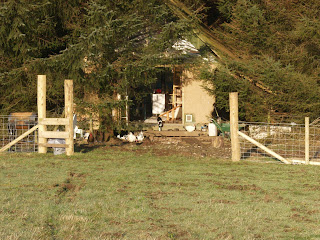
My (entirely illegal) house.
If poor people spend all the money they can raise to buy land, they are unlikely to have money available to build dwellings immediately afterwards. If they were to be able to raise money to build in the mainstream mortgage market, then neither liferent nor Rural Housing Burden would be viable. Therefore, unless there is public money available, legal dwellings cannot be built quickly. Even with access to public money available, it's going to take some time for legal dwellings to be built. And in the meantime, the crofters need somewhere to live while they develop their crofts and build their legal dwellings.

In brief, the law of the land is that you can't live in temporary structures except temporarily, but you can live in a temporary structure while you're building yourself a dwelling for which you already have planning permission. Given that there must be a presumed consent to construct one dwelling on each croft, it doesn't seem unreasonable that there should be toleration for one household to live in temporary structures on each croft until that dwelling is built. There might be a time limit on this - perhaps ten years - but there needs to be some flexibility.

Changes to community right to buy

The community right to buy is a scheme which provides some public money for communities to buy land or fixed assets subject to some conditions. One of the conditions is that the 'community' is a pre-existing community of place: the people who already live in an existing settlement. This is more or less meaningless when the 'communities' are composed primarily of the non-native elderly. The non-native elderly don't have a long-term investment in an area, and won't be around to see longer term schemes coming to fruition. And, of course, in the most devastated areas of remote rural Scotland, there are no existing communities of place; the landscape is largely or wholly unpeopled.

Also, for new communities to work, they need to be communities of people who can agree ground rules by which they will live and work together. Such people will not necessarily all come from the same settlement or even from the same area. They will be new, intentional communities. New intentional communities do not currently qualify to access public money under the community right to buy.

I'm not suggesting that new intentional communities should be able to exercise the pre-emptive parts of current or future community right to buy legislation; they should be able to apply for public money only to buy land which is already on the market. The public money would not necessarily have to be a grant; it could be in whole or in part a long term low interest loan, because it is not unreasonable to require some financial contribution from crofters proportional to their earning power in the remote rural economy.

Such public money would have to be on the condition that all houses built on the land acquired should be subject to the Rural Housing Burden - otherwise this just becomes a new way for people to profiteer from speculative building.

I'd also like to see a scheme under which 'Standingstone model' communities, once they'd acquired their land, could borrow for finance to construct dwellings, and could do so on the basis that the labour would be provided by the community itself. This would not need to be public money, it's entirely possible that the financial services industry could lend given appropriate guarantees; but there would have to be some degree of legislative support for such a scheme, and some degree of public guarantee would also be welcome, since if private lenders could repossess crofts and sell them on the open market we'd be back to having a backdoor mechanism for building speculative retirement homes.

Saturday, 21 July 2018

The minimum viable village

Hay Harvest
This blog post is occasioned by the National Council of Rural Advisers' consultation on Rural Economic Strategy. It isn't directly a response to that consultation, but I'm writing it to help formulate my thoughts in order to respond. A lot of the figures in this piece come out of my Minimum Viable Village Model.

In this essay as in other essays I treat it as axiomatic that the economy should serve the people, not the people the economy. I also treat it as axiomatic that a settled landscape is a good thing in itself. I'm not going to argue those propositions; if you disagree with either of them, then you will disagree with my argument and my conclusions, and that's just how it is.

There are a number of key problems with Scotland's rural economy. The first is population density. It takes about 270 adults of working age to produce enough children to maintain a viable primary school. Currently, average agricultural holding size in Scotland is 101 Ha and rising; increasingly, those holdings are each providing only one income. That means, given coast, forestry, and unfarmable land, there are about 40 holdings and consequently about 40 farm incomes in a 5Km travel-to-school radius.

Consequently, to sustain a viable village school you need about 200 non-agricultural incomes per village, and those incomes must be within a viable travel to work radius.

You also need affordable housing for 270 adults per village. Typically, in rural Scotland, wage rates are depressed, while housing costs are inflated by people from outwith the rural economy buying retirement and holiday homes.

This is just another example of the fact that capitalism simply doesn't work for people, and that we spend an awful lot of time and effort working around the manifest failings of capitalism to produce an economy which supports the many. What the Scottish rural economy needs is full communism now, but we aren't going to get that, so we need to keep on tinkering with the margins of a broken economy.

But one thing we can tinker with is planning law. If people are going to live in the landscape, on the depressed wages which are probably inevitable in rural areas, then they need to leverage the advantages of rurality to make their lives viable and fulfilling, and that means they need land - to grow food for themselves, reducing their costs, and to increase their amenity.

They also need housing that they can afford, and which is not subject to 'market forces'. Which means, essentially, they need housing which cannot be traded on the open market. And they need non-farm economic opportunities, which means we need more rural workplaces.

Planning policy over my lifetime has been hostile to 'sporadic development', and very hostile to village industry. Houses have been huddled together in ever expending villages of urban density, while industry has been pushed to the outskirts of far-away towns. That won't do. The Internet does allow far more folk to work from home, but rural areas typically have the worst Internet connections.

In any case, people go to work (among other things) for social contact; and Scotland needs engineering production at least as much as it needs jobs that can be done in front of a screen. But for both these things - if we are to support a peopled landscape - we need the work where the people are, and if we want the people distributed across the landscape, then so must the work be.

So: we need smaller holding sizes, not larger ones, to put more folk on the land. We need sporadic development in the countryside, because people need to live on the land they manage We need more workplaces, because smaller holdings won't necessarily provide full incomes, and in any case agriculture will only employ 20% of the population we need to sustain. And we need the workplaces where we want the people to be, which means sporadically, in the landscape.

But we don't need those sporadic homes bought up by the rich retired, or the even richer second home buyer. We need them lived in by the people of the place; people who will at some stage in their lives, have children for the school. People embedded in the landscape, who are intimate with it, who know it and care for it, and are committed to it in the long term.

For all those reasons I think these houses we need should not be privately owned. They should be community owned, and let to members of the community on a life rental - a tenancy which is secure for the whole of the tenants' lifetime, but which is not transferrable or heritable. People need security; but inherited wealth is the key driver of social inequality, and, in any case, that which can be inherited can very often also be sold.

As I said at the beginning of this piece, what the Scottish rural economy needs is full communism now.

Thursday, 19 July 2018

Response to the consultation on the Register of Persons Holding a Controlled Interest in Land

My croft
Environment, Climate Change and Land Reform Committee

Land Reform (Scotland) Act 2016 (Register of Persons Holding a Controlled Interest in Land) (Scotland) Regulations 2021 - Call for Views

SUBMISSION FROM Simon Brooke


Preamble

Much land in Scotland is held by extremely wealthy individuals who chose to use opaque ownership structures to avoid taxes or other civil duties. There is no reasonable justification for an honest person to use opaque ownership structures or secrecy jurisdictions. Such people have the ability to hire extremely ingeniuous lawyers to work around the intention of legislation, as we saw with Agricultural Holdings (Scotland) Act 2003.

Consequently, legislation aimed at cutting through this veil of secrecy must be simple, clear, and free of weasel-words like ‘reasonably’. Further, because of the degree of wealth (and the penchant for secrecy) of some of these individuals, fines are unlikely to be effective deterrents.

Failure of undisclosed controllers of land to register

Consequently, there’s not a lot of purpose in being able to fine persons with a controlling interest in land where the ownership structure is opaque and held offshore in a jurisdiction in which the writ of the Scottish Government does not run, and the persons choose not to disclose their interest.

Instead, the Government should establish a Public Factor, who should take over the management of lands where the the controlling interest cannot satisfactorily be established, and manage that land in the public interest, retaining any and all profits, until the natural persons with a controlling interest choose to identify themselves and register their interest to the satisfaction of the registrar.

Non-natural persons

Non-natural persons should not be deemed ‘controlling interests’ for the purpose of this legislation. Behind every non-natural person are natural persons who control them. We need to disintermediate this, radically. Non-natural persons, having a controlling interest in land, should be required to register those natural persons which ultimately have controlling interests in themselves; otherwise, the value of the register is negligible.

Redactions and elisions

While I understand the force of the points made in para 71 of the Draft Explanatory Document, the power of the registrar to make redactions or elisions from the public register should be sharply circumscribed, and should in my view be limited to those cases where the personal safety of natural persons can be shown to be at risk.

Friday, 6 April 2018

Response to consultation on a new enterprise agency for the South of Scotland

1 Do you agree with our ambition outlined?

Yes

2 What would you like to see for the South of Scotland?

Locally owned businesses, rather than inward investment. The current problems at Pinney's just reprise the history of firms like Stelrads; investors from outside the region are attracted in with generous grants, stay for the good times, and pull out suddenly when times are tough. That isn't what we need.

What we need is to develop and grow a vibrant entrepreneurial culture locally. That means training in entrepreneurship, mentoring networks, and, ideally, if they can be found, local angels. It also means facilitating local business and tech meetups.

I'd personally like to see more high skill high wage businesses, like software and engineering, and less emphasis on low wage, insecure businesses like hospitality and tourism. As agriculture adapts to a low carbon economy, there are huge opportunities for disruptive new engineering products.

3 What are your ambitions for the future economic success of the South of Scotland?

Innovative engineering, especially around reducing fossil fuel use in agriculture and forestry.

A broad entrepreneurial culture, with school leavers and university graduates equipped with the skills and confidence to start their own businesses; supported by
  1. a mentoring network.
  2. A local angels/venture capital network, and a local business focussed bank after the German model.
  3. The ability to develop businesses where people want them, not where it's convenient to central planning.
In particular we need employment in villages, and employment flexible enough for people supplementing reduced agricultural incomes.

4 What are the strengths you would like to see the Agency build on?

As outlined, we're a dispersed region with significant opportunities in renewable energy, a highly educated workforce, and, in places, considerable self reliance.We also have land, although it is concentrated in few hands. Land-based businesses over the 20th century became heavily dependent on fossil fuels and that now has to change rapidly. That's a challenge, but it's also an opportunity. Southern Scotland has a history of agricultural innovation - for example, the milking machine was invented in Castle Douglas. We can respond to this challenge.

We lack confidence, finance, and entrepreneurial skills. We need to make up these deficits, and that's something an agency would be well placed to do. We also, relative to urban areas, lack informal opportunities for entrepreneurs to network, and that also needs to be addressed,

A local business bank would be a great asset, either as a strictly commercial business or as a mutual.

5 What are the economic challenges you would like to see the Agency address?

  1. Infrastructure, especially communications.
  2. Finance.
  3. Entrepreneurship training and mentoring.Research and development support.
  4. Networking, meetups, matchmaking.
  5. There is a problem with affordable housing for young people. If people are borrowed up to the hilt for housing, or paying a burdensome rent, the amount of risk they can afford to take on in business is sharply limited.
  6. Universal Basic Income would considerably de-risk business startup.

6 What currently works well in the South of Scotland?

Not a lot.

7 What would you add or take away from the potential activities that the Agency could carry out across the three areas:
a) drive forward the economy?:

While opportunities are great, we need to be aware of risks and challenges. Scottish agriculture is not equipped to compete at world market prices, and Brexit will mean widespread farm bankruptcies across the region with consequential bankruptcies among farm supply businesses and more widely.

The challenge for the rural economy over the next decade is to maintain people in their homes in the face of rapid change and stress. Challenges are opportunities, and there are considerable opportunities in the current situation. But we need to be clear that the requirement, before seeking to drive the economy forward, is to prevent its utter collapse.

b) sustain communities?:

The costs and models of rural transport are going to change considerably over the next decade, and the prospects are not easy to predict. Because the rural economy is relatively depressed and electric vehicles are new and expensive, it's unlikely that they will naturally propagate into the rural economy first; rather, they're likely to be in the towns.

There's a related issue that most remote rural areas have great opportunities for renewable electricity generation, but lack the grid connections to carry that power away. If it could be used locally to power transport and farm machinery, that's a triple benefit to the rural economy.

If we expand electric vehicle use rapidly and early in remote rural areas, that will cut the costs of rural transport very substantially, leading to much more sustainable communities; driverless, on demand electric taxis following the Google/Waymo model could have a very positive impact.

But without government intervention and considerable subsidy, neither will happen. The richer, urban economy will soak up these new products first, and remote rurals will get them only when that market becomes saturated. Instead it's likely that private rural transport will tend to depend largely on second hand diesel vehicles, because they're cheap to buy and reliable; but they will increasingly be more expensive to run. This further disadvantages rural areas with respect to urban.

Without affordable transport and access to affordable housing and land, the pattern of a populated landscape and vibrant village communities will be very hard to sustain.

c) capitalise on people and resources?:

We don't educate nearly enough in entrepreneurship or in civics. Young people leave education expecting to get a job, not start a business. They lack the skills and they lack the mentoring network.

A related problem is that most of our young people go away to distant universities, and, because of the cost of housing and the few opportunities for employment, few come back. Of those of my generation from Auchencairn who went to university and did not inherit farms, only two - myself and one other - came back.

Full disclosure, I started my first business in Auchencairn at the age of 21; it was a steep learning curve, but was supported by good mentoring from Scottish Enterprise for which I'm still grateful.

So: we need better education in entrepreneurship at all levels, a wide network of good, easily accessible mentoring, and affordable housing and business premises. The second and third of these are things the new agency can contribute greatly to.

With regard to resources, our primary resource after people is land and landscape. Landscape, as a marketable asset, derives from cultural aesthetics which are inevitably somewhat backward looking; people like to see (and to live in) a settled, patchwork landscape of mixed farming, woodlands and hills. They like to see in that landscape a broad diversity of wild flowers, birds, and other wildlife.

This is not from an agricultural point of the most efficient landscape. As pressure grows on farmers, we will see less employment, less varied agriculture, a less settled and less diverse landscape. Beef, lamb and cereal production will cease to be economic as we open up to world markets, increasing the reliance on dairy, and, probably, on cows kept indoors and fed silage.

If we are to protect a settled landscape, we need ways to subsidise small farms. I believe that moving from a per-hectare model of agricultural subsidy to a welfare model - preferably a universal basic income model - together with opportunities for part-time employment, would encourage a settled, more diverse landscape, which would in turn bring benefits to tourism.

8 What would you prioritise as the key areas of activity for the Agency?

  1. Building mentoring networks.Facilitating meetups/informal business networking.
  2. Encouraging entrepreneurship education, including on-going education for existing business owners.
  3. Providing/gatekeeping access to local angels.
  4. Encouraging the establishment of a regional business-oriented bank.
Politicians like inward investment because it provides sudden, relatively large job creation which they can take credit for. This is a snare and a delusion. As the south of Scotland has seen repeatedly over the past century, inward investors become outward divestors at the first sign of trouble. The agency should NOT support inward investment.

9 What specific things could the Agency do to help you, your business, your sector or your community?


  1. My business? Better broadband; business networking.
  2. My sector? Better broadband; business networking.
  3. My community? Affordable housing. The average income is about £21,000, the minimum house price is about £200,000, the two don't meet.

10 What could the Agency do outwith its boundaries working with other local authorities or with agencies like Highlands and Islands Enterprise to support specific projects which benefit the South of Scotland and with national agencies?

East to west travel across southern Scotland is not facilitated by either the road or rail network, and consequently there is not much communication between Dumfries and Galloway in the west, and the Borders in the east; rather, Galloway tends to face Ayrshire and Glasgow, where the Borders tend to face the Lothians and Edinburgh. It does not therefore seem to me that, despite the similar challenges, it will be easy for one agency to service all these regions.

In particular an agency headquartered in the Borders will find it hard to service Galloway, while one based in Dumfries will find it hard to service Berwickshire; sadly, one based in Langholm would find it hard to service anywhere at all.

In Scotland we over-centralise everything; Dumfries and Galloway, considered as a unit, is larger both in area and in population than one sixth of the independent nations of the world. On average across Europe, local government units are one twentieth the size they are in Scotland. I do not believe this can continue; I believe the democratic deficit must mean that we will soon see the break up of these monstrous local government divisions.

Nevertheless, there is a clear geographic divide running to the east of Moffat and Langholm, Without major new roads infrastructure, despite the similarities in economic challenge, it is not useful to see the whole of southern Scotland as one unit. While I think Dumfries and Galloway council is an oversized and anti-democratic anachronism, an economic development agency for the south-west would make sense.

11 Which option, either from the list above or your own suggestion, do you think offers the best way to ensure the Agency is accessible to all across the South of Scotland?

Of the options listed I would go with the first: 'the Agency could have minimal physical presence with its services delivered digitally across the area', supplemented by local, probably part time, networking and mentoring staff dispersed across the region.

There is no location which could reasonably serve as a 'headquarters' for the whole of southern Scotland, because there is effectively no transport infrastructure between east and west.

12 Which criteria should be used in reaching a decision about the location of the Agency?

Don't locate it. That is a snare and a delusion. A centre in Dumfries could service the southwest, but not the Borders. One in the Selkirk/Melrose area could service the Borders, but not the southwest.

Obviously in my personal interest it would be better in Dumfries than in Melrose, but that's exactly the point; getting bogged down in squabbles about location doesn't help, and whichever location were chosen, unless the Scottish Government is prepared to invest in a Stranraer to Melrose motorway, the side of the country not chosen will feel discriminated against.

Board meetings and other central functions should rotate across the whole area, rather than being centrally located; staff should be dispersed.

13 If you were to use the services of this Agency, what factors are important to you in terms of reaching it?

Digital delivery is still problematic across much of rural Scotland: broadband speeds are laughably poor - I'm currently seeing 0.9 Mbits/sec download and 0.3 upload, and I run an Internet business!

Without better broadband performance digital delivery alone will not service remote rural areas.
So until we have the broadband we've been promised for the past twenty years, the agency would need to work on an 'account manager' model, with dispersed, locally based, probably part-time account managers regularly visiting their client businesses, probably as part of a mentoring/support scheme.

14 What sort of people should be on the Board of the Agency and what sorts of skills and expertise should they have?

A board widely drawn from experienced local business people - not politicians nor career public servants.

15 We know that young people are less likely to stay in or move to the South of Scotland than they are other parts of the country. Do you have any comments on things the Agency could do to meet the interests of children and young people?

We need homes for them to come back to after university, and opportunities to create their own employment in the form of flexible, low-commitment business premises. Ideally we need either universal basic income or an enhanced enterprise allowance to de-risk at least the initial three years.

We need opportunities for part time employment so that people not able to make a sufficient income from a nascent business can supplement it.

But most of all we need housing. And the housing we need has to be affordable in perpetuity, so either we need sufficient council housing of sufficient quality to be both available and attractive to potential entrepreneurs, or else we need to make the Rural Housing Burden actually work.


19 Do you have any other thoughts on powers that the Agency will need?

There will be a great deal of pressure for the agency to intervene in situations like Pinney's. Pinney's is a tragedy, but it's one that is an inevitable consequence of businesses being owned from outwith the region, and of Brexit. We will see more instances of this over the coming years, and they could easily soak up all the resources of the proposed agency for years to come.

Furthermore, paying bribes to businesses based furth of Scotland to keep open businesses in Scotland, even if it preserves employment in Scotland, is poor use of Scottish government money.

The agency needs to have the independence to be able to resist political pressure to intervene in saving failing businesses. This isn't to say that the agency might not back a management buy-out, or some other scheme which brought ownership of a facility back into the region, provided that the facility was viable as a business or could reasonably be expected to be brought into a condition in which it was.

I don't think the agency should have the power to invest directly in businesses; I think that it should seek to encourage and support a network of angels, or a local venture capital group, and a regional commercial bank.

20 Is there anything else you wish to say about the operation of the Agency?

Keep it lightweight, keep it dispersed, don't spend money on fancy headquarters of large central staff.

Monday, 9 October 2017

The place you call home

The place I call home
It's no secret that I live in an illegal house (you might call it a hut, a bothy, a shack, whatever). Most of my neighbours also live in informal dwellings - old vans and buses, old caravans, yurts. It's pretty common in this parish, because legal housing is unaffordable for many people. How common it is across Scotland I don't know, and I don't think anyone knows. I think it would be worth trying to find out.

So, if you live in an informal dwelling - that is, anything that isn't a legal house or flat that you legally own or rent - anywhere in Scotland, I'd like to talk to you. I've got a set of questions I'd like to ask you. Ideally I'd like to come and see you, but I can't come everywhere and see everyone, so some at least of this needs to be done by email or telephone. Ideally, if you'll permit it, I'd like to have a picture of where you live (although I understand that many people will feel anxious about this, so if you don't allow it I perfectly understand). But first, I've a web form you can fill in - and if you live in an informal dwelling I'd be really grateful if you would. It's completely anonymous.

Obviously, informal chats with self-selected folk don't produce hard, numeric data. That needs a census, and at the time of the last census, when I was sleeping rough, I couldn't even get the census people to send me a form, although I asked for one. But if we can put together at least some impressionistic data on what sorts of people are living in informal dwellings, and what (if anything) their needs are, I think that would be useful

Anything I am told, I will anonymise. I won't publish who you are, or exactly where you live (although I'd like to be able to say, for example, "I spoke to twenty people living in Galloway").

If you live in an informal dwelling (including squatting, couch-surfing or sleeping rough) and are prepared to talk to me, please let me know - either by commenting on this blog, or by emailing me.

Tuesday, 24 January 2017

Hard Cheese

Draft response to Food Standards Scotland's consultation on its regulatory strategy.

Nothing is without risk. All foods have health benefits and disbenefits, some of which are now well understood and some which aren't. Attempting to create a perfectly safe food environment is beyond the scope of modern dietary science. In particular an auto-immune system which is never challenged does not develop resilience necessary for good health; for example, pasteurisation has been associated with the rise in allergies.

There's no doubt that FSS policy to date has been highly detrimental to small innovative food businesses. The destruction of Errington's Cheeses stock on the basis of tenuous and unproven evidence - effectively, on the basis of pure prejudice - has had a very chilling effect on the ability of small food businesses in Scotland to raise capital and find investors. This runs directly against your proposed outcome of 'Enabling business compliance and growth', and detracts sharply from your proposed outcome of 'FSS is a trusted, empowered and effective regulator'.

It is obviously imperative that FSS use 'evidence based decision making', but that 'evidence' has to be open and transparent, and FSS has to be able to communicate clearly to the public exactly on what evidence its decisions are made. Otherwise there will be a widespread perception that FSS favours large industrial processors over smaller artisan businesses.

Commodity milk production in Scotland is now viable only at scales which militate against acceptable standards of animal husbandry, and which generate very little rural employment. If we're to retain a viable population in remote rural areas we must be able to create more jobs per thousand hectares, which means we must be able to add value to primary production at the farm gate; which means in turn that we must process our primary products into higher value products which escape the commodity pricing trap. This observation is made all the more true post Brexit, when we're likely to be forced to compete with food produced in global markets in which standards of animal husbandry are significantly below those which would be acceptable here.

If Foods Standards Scotland are able arbitrarily and impunity to close down any small food business,  this will result in increased rural poverty and depopulation, and lead to more villages ceasing to be able to support services such as shops and schools. Food standards do not exist in a vacuum, but in a wider context of policy objectives and desiderata. We could achieve perfectly healthy food production in Scotland by ceasing to produce any food in Scotland, but that would have serious social and economic consequences, as well as consequences for food security and resilience.

Obviously it is more complex and more costly to inspect and monitor many small producers distributed over remote rural areas than a few large industrial plants in urban settings. Obviously there are risks associated with small scale food production. Obviously there is a role for regulation and for inspection. But FSS must reverse the perception which it has established that it closes smaller businesses arbitrarily and without compelling evidence.

As you say in 2.10a, 'establishing trust is vital'. You are signally failing to achieve this.

In summary, bland words about 'evidence based decision making', 'transparency', 'minimising burdens on business' and 'promot[ing] mature and open relationships' are easy to write, but much harder to implement; and you have got off on a bad foot.

While I broadly welcome the words in your draft strategy, I have much less faith in your ability or even willingness to make good on them.

Monday, 10 October 2016

Cycling as a mode of transport in remote rural Scotland

My cross bike and trailer, on the way home from Castle
Douglas with groceries.
Following the Dumfries and Galloway Local Transport Summit, at which the Scottish Government completely failed to consider active transport as a component of the transport issues in the region, a sort-of consultation has been opened. Cycling Dumfries have more to say on this (and how to submit your thoughts) on their website. Here is my response, which I've already sent to dandgsummit@transport.gov.scot:

Much of Galloway, and some of Dumfriesshire, is remote rural. Public transport options are extremely limited, and distances are considerable; for example I am more than ten miles from my nearest health facility or supermarket, and the only shop nearer than that is extremely small and has very limited hours.

In common with many other remote rural areas across Scotland, local wages are significantly below the national average. The combination of significant distances and low wages make cars unaffordable to many, and of course there are others who, because of age or infirmity, cannot drive. This observation applies equally to secondary school pupils as to the elderly. In the absence of frequent public transport - and in many places, the absence of any public transport at all - this leads to isolation.

It's hardly surprising given this overview that cycling is an extremely popular activity in the area. Castle Douglas, a town of 4,000 people, supports three specialist bicycle shops, while each of the neighbouring towns have at least one. This is partly due to the presence in the area of extremely good off-road recreational cycling facilities, but not wholly. Even a casual observation of Galloway's roads will reveal a high proportion of utility cycling - most particularly in and around Kirkcudbright.

Utility cycling has a real potential to improve health, decrease isolation, and provide access to services for a significant proportion of the remote rural population. Compared to cars, pedal cycles are inexpensive to buy and extremely inexpensive to run; fitted with luggage trailers or pannier racks they can effectively replace cars for many shopping trips as well as providing access to social events and healthcare. In summary, utility cycling should be seen as a critically important tool in improving the lives of the rural young and the rural poor, while having a contribution to make to the lives of rural people more generally.

Deterrents to the growth of utility cycling in remote rural areas include the high speed of traffic on rural roads and the lack of cycle parking facilities in villages and towns. In particular a lowering of speed limits on unclassified rural roads could be significantly beneficial.

Thursday, 6 October 2016

The party of the lairds

Last week I posted my letter to Richard Arkless MP about the driven grouse petition. Here's his reply, in full. Needless to say, not for the first time, I'm bitterly disappointed by the cravenness of 'Scotland's Party'. In short, if you think the SNP will stand up for the people of rural Scotland who disproportionately signed the petition, don't be so fucking naive.

Dear Simon,

Thank you for taking the time to contact me regarding grouse shooting. It is really good to hear from you.

I should say at the outset that responsibility for the environment and for wildlife management is devolved to the Scottish Parliament. I fully recognise the positive role that is played by shooting estates in the management of Scotland’s natural environment and in wildlife conservation, as well as the positive effect on employment in rural areas, and the Scottish Government will continue to work with shooting estates to achieve positive outcomes in this area. The Scottish Government and Scottish Natural Heritage support the Wildlife Estates Scheme – an initiative to encourage high standards of wildlife management led by Scottish Land and Estates – and also values Scottish Land and Estates’ role in the Partnership Against Wildlife Crime. I also recognise that well-managed grouse moors can make significant contributions to biodiversity targets, particularly with regard to upland wader species such as lapwing, curlew and golden plover.

Moreover, the Scottish Government’s Land Reform Act 2016 will help to ensure that Scotland’s land works for all of those who live and work on it. The measures in the Act will help to further encourage and support responsible and diverse land ownership, and ensure that communities have more of a say in how land is used.

In connection to this issue, I appreciate that many of my constituents are concerned by wildlife crime. The SNP Scottish Government has already introduced measures to tackle wildlife crime which are greater in scope than those employed in England and Wales, including the criminalisation of poisons commonly used to persecute raptors, the suspension of general licences where areas are being used for wildlife crime activities, and the introduction of vicarious liability, which has so far resulted in two successful prosecutions.  The fight against wildlife crime remains a high priority for the SNP Scottish Government, and of course all shooting businesses must comply with the law. I am confident that the Scottish Government will consider further measures for protection if current measures are found to be insufficient.

I trust that this is helpful in outlining my position, and I would encourage you to make contact with your Members of the Scottish Parliament (MSPs) to inform them of your views.

If I can be of any further assistance with this or any other matter, please don't hesitate to let me know.

Best wishes,
Richard

Monday, 3 October 2016

Don't just grouse about it

The driven grouse petition is due to be debated in the House of Commons on October 18th. If you haven't already done so, now is the time to write to your MP and urge them to support a ban.

Here's my letter. Please don't just copy it, because duplicate letters have less effect, but feel free to take inspiration from it. Other sources of inspiration include the blogs of Raptor Persecution Scotland and the Wildlife Detective.

Dear Richard Arkless,

You'll likely not recall me; we have met, and I delivered leaflets for you at the last Westminster election. I'm writing to urge you to support a ban on driven grouse shooting. There's to be a debate on the petition on 18th October, which I would appreciate it if you'd attend.

Key points from a Galloway perspective are:

This is a local issue and a current issue. Our eagle population is very small and very threatened. We have two nesting pairs. Yet, from that critically small population there's regular attrition. One was shot on a grouse moor near Wanlockhead in 2012; one satellite-tagged bird from Galloway 'disappeared' on a grouse moor in the Cairngorms this May. These of course are the birds we know about, one because it was found by a member of the public, one because it was satellite tagged. The number of Hen Harriers killed in Galloway is something we simply don't know at all, but they too are critically rare.

Wildlife tourism benefits Galloway. The successful reintroduction of Red Kites in the Glenkens is estimated to be worth £21 million to the Galloway economy. A more vibrant eagle population, making it easier for tourists to see eagles, would undoubtedly increase this further.

Grouse moors, by denuding steep slopes and high hill land of trees, greatly contribute to flooding in towns such as Newton Stewart and Dumfries at a cost of many millions to the local economy.

In short, driven grouse shooting provides entertainment for a very small number of very rich people at cost of promoting extensive criminality, environmental degradation, and significant losses to property. It has no place in modern Britain.

Yours sincerely,

Simon Brooke

Consultation on the future of forestry: my response

My house, in the middle of my, err, wood.
This is my response to the Scottish Government's current consultation on the future of forestry. It isn't terribly exciting, but it's here for the record. The consultation questions are in italics. It may be noted that some of my responses are somewhat tart.

1 Our proposals are for a dedicated Forestry Division in the Scottish Government (SG) and an Executive Agency to manage the NFE. Do you agree with this approach?

Yes

2 In bringing the functions of FCS formally into the SG, how best can we ensure that the benefits of greater integration are delivered within the wider SG structure?

While I understand the motivations for bringing an arms-length public body back into government and broadly agree with the approach, any benefits are for government. It won't really have any significant effect on forests, foresters, forest managers or the public at large.

What additional benefits should we be looking to achieve?

We should be seeking to achieve much greater local and community control of Scotland's forests.

The Forestry Commission was set up with two primary objectives: to provide a strategic timber resource, and to keep people on the land. It largely succeeded in the first, and wholly failed in the second; and I would argue that it failed primarily because of over-centralisation, taking all decision making power and planning away from communities, and consequently deskilling them.

3 How should we ensure that professional skills and knowledge of forestry are maintained within the proposed new forestry structures?

By keeping the central unit extremely small, and devolving as much capacity as possible to communities.

4 What do you think a future land agency for Scotland could and should manage and how might that best be achieved?

All land is local. There is no place for a central land agency, except as a co-ordinator of last resort. Land is a matter for community councils, not central government.

5 Do you agree with the priorities for cross-border co-operation set out above, i.e. forestry research and science, plant health and common codes such as UK Forestry Standard?

No

6 If no to question 5, what alternative priorities would you prefer? Why?

It is completely the wrong time to be talking about 'cross border arrangements', since we do not know what nation we will be in in five years time, let alone which trading blocks.

Of course tree diseases do not respect international frontiers and some degree of co-operation will be needed in future, but it would be completely wrong to predicate these arrangements on the continued existence of the UK, since that frankly isn't very likely.

7 Do you have views on the means by which cross-border arrangements might be delivered effectively to reflect Scottish needs?
For example: Memorandum of Understanding between countries? Scotland taking the lead on certain arrangements?

In the immediate future, when we do not know what future constitutional arrangements and treaty obligations will be, we should proceed on the basis that Scotland may or may not be in any of the UK, the EU, or the EEA. We don't know, and we can't pretend we know. So without behaving undiplomatically, we should not predicate arrangements on the assumption of any of these positions.

It would, obviously, be in the interests of Scottish forestry (as of all other aspects of Scottish life) to resolve this uncertainty sooner rather than later.

8 Should the Scottish Ministers be placed under a duty to promote forestry?

Yes

9 What specifically should be included in such a general duty?

Forestry is, in much of Scotland, not a very certain commercial investment, but has many non-commercial benefits, in the form of environmental improvements and amenity, carbon capture and storage, carbon-neutral domestic fuel, flood water control, wildlife habitat, and so on.

Forestry has particular importance in binding topsoil on steep hillsides, preventing erosion, and, gradually over time, improving soil fertility. And, as deforesting hill land has been a primary cause of catastrophic flooding in Scotland's towns and lowlands, it is reasonable to charge those who maintain deforested hill land with the cost of that flooding.

But forestry as a major land use cannot be considered in isolation from the more general issues of land reform. The land, in Scotland, is overwhelming in the hands of a tiny plutocratic elite. It cannot be justifiable to spend public money bribing the already very wealthy to mitigate the harm they cause to their poorer neighbours.

Consequently, public subsidy to forestry should be limited strictly to

  1. community owned land, or
  2. holdings of fewer than 100Ha.

10 Recognising the need to balance economic, environmental and social benefits of forestry, what are your views of the principles set out in chapter 3?

The principles set out in Chapter Three are apple pie; I doubt you will find any voices disagreeing with the thought that forestry should be promoted, nor that it should be sustainable, nor yet that the environmental, commercial and amenity interests should be 'reasonably' balanced.

The principal that governance of Scotland's forests should be repatriated to Scotland is in my view a good one, but as this will be an almost inevitable consequence of the chaos and catastrophe of Brexit it hardly needs comment.

In short it matters less what the principles are, and more how they are applied. But there is one principal that might well be added:

Forest policy should aim to promote community ownership and diversity of ownership of Scotland's forests.

11 Are there any likely impacts the proposals contained in this consultation may have on particular groups of people, with reference to the ‘protected characteristics’ listed in chapter 4? Please be as specific as possible.

There are many people in Scotland who are now landless, who wish to have access to land, and who are denied access to land by the pattern of land ownership. It would be wonderful if a consequence of the changes in this proposal were that it should make land available to such people. However, the thing which characterises these people is that they are rural and that they are poor, and neither of these things is a 'protected characteristic'.

12 Do you think that the proposals contained in this consultation are likely to increase or reduce the costs and burdens placed on any sector? Please be as specific as possible.

I see no reason why they should do either. The proposal is to replace one system of public administration with another, which will have broadly similar remit and competences.

13 Are there any likely impacts that the proposals contained in this consultation may have upon the privacy of individuals? Please be as specific as possible.

These proposals cannot be considered other than in the context of land reform, and, in particular, reform to land ownership documentation. It is essential that the beneficial ownership of Scotland's forests, as of Scotland's other land assets, should be on public record. This has an impact on the 'privacy' of Scotland's elites, and may be expected to be resisted vigorously by them. It is, ultimately, on its courage and its preparedness to stand up to elites in the public interest that this government will be judged.

14 Are there any likely impacts that the proposals contained in this consultation may have upon the environment? Please be as specific as possible

We may hope that repatriating the governance of Scotland's forests may result in better environmental management at the margins, but since this will be essentially the same officials administering broadly the same policy it is inconceivable that there will be significant impact.

15 Do you have any other comments that you would like to make, relevant to the subject of this consultation, that you have not covered in your answers to other questions?

Events march on. As I write, the date for the UK government to make its Article 50 declaration, and, in consequence, the likely date of the next independence referendum, has just been set. It is highly likely that this consultation will be overtaken by events.

Creative Commons Licence
The fool on the hill by Simon Brooke is licensed under a Creative Commons Attribution-ShareAlike 3.0 Unported License