Showing posts with label Politics. Show all posts

Monday, 15 November 2021

The Everyone Dies Event Class

Lytton burns
The climate, globally, is warming. Everyone acknowledges that. It’s not warming equally, or consistently, or evenly; I think everyone acknowledges that as well. Rather, the atmosphere is a heat engine: as you put more energy into it in the form of heat, you get more work out of it, in the form of turbulence. Winds get stronger, precipitation more intense, and heat waves hotter.

Human beings function in a fairly constrained temperature band. The healthy body temperature is 37° Celsius, plus or minus about one degree. The human body cools itself by evaporation. If water can’t evaporate from your skin, you can no longer cool yourself. Rather, you take on heat from the environment. Body temperature above 40° Celsius is a life threatening emergency, and above 42.3° denaturing of proteins, especially in the brain, may occur rapidly. This is not survivable.

But the operation of the human body generates heat continually. The beating of the heart generates heat. The movement of the chest cavity in breathing generates heat. Even brain activity – thinking – generates heat.

So in order to survive we need to be able to dump a small amount of heat into our environment continually. If the air is humid enough that sweat can’t evaporate, we need a small heat gradient to make that possible. So we need it to be actually cooler than 37°, and the survivable number generally quoted is a “wet bulb temperature” of 35°.

What does ‘wet bulb temperature’ mean? It’s the temperature at which water (and sweat) evaporates, and that’s a function of the absolute temperature of the air, and of the humidity: the saturation of water vapour in the air. As the air becomes increasingly humid, so the wet bulb temperature falls. In very dry atmospheric conditions, you can easily survive air temperatures well above 35° Celsius, provided you can drink enough fluids to enable you to sweat.

So: there is a temperature and humidity at which everyone exposed to the air just dies, and just dies pretty quickly. How close are we to hitting those temperature and humidity conditions?

The answer, of course, is that there are places on Earth which regularly exceeded those limits even before the days of significant anthropogenic warming, but that people don’t live in those places. Examples include Death Valley in California, parts of the Arabian Peninsula and of the Sahara, and Pakistan’s northern Sindh province, in which a Victorian British Brigadeer had the bright idea of building a city. What’s interesting is that these are not generally humid places; on the contrary, they’re exceptionally dry.

But the consequence of anthropogenic heating is that we’re seeing both higher average temperatures and higher variations in temperature. Which means we’ve been seeing a lot more exceptional heat events than we’ve been used to.

Over the past decade, ten places on Earth have recorded wet bulb temperatures at or above the theoretical ‘everybody dies’ limit. So far, we haven’t had an event in which very large proportions of the population have died suddenly of heat stroke, despite the fact that three of the places which have seen the highest wet-bulb temperatures, Ras Al Khaimah, Jacobabad and Mecca have significant populations.

But we cannot be very far away from an ‘everybody dies’ event, and the first probably won’t be somewhere that’s accustomed to very high temperatures.

Lytton, in British Columbia, Canada, wasn’t, until this year, accustomed to exceptionally high temperatures. Yes, it had frequently been the hottest place in Canada, but Canada is not on the whole a very hot place. The extreme heat event that hit Lytton in June 2021 – 49.6° Celsius – was fully 5° Celsius warmer than had ever been recorded there before. This is, as I’ve said before, because having more heat in the atmosphere makes it more turbulent and thus more heterogenous.

Lytton is 50°13’52" North. For comparison, that’s about eleven miles south of Plymouth in Devon, England, or about six miles north of Prague, in the Czech Republic.

Lytton didn’t quite exceed the ‘everybody dies’ limit, although it came very close. But it did exceed the ‘everything burns’ limit, which is what it isn’t there any more. And what Lytton proves is that, in an era of increasingly unstable weather, extreme heat events do not only happen in the tropics.

So:

  1. We’re currently on 1.19° Celsius of anthropogenic warming over pre-industrial levels;
  2. At 1.19°, we’re seeing local temperature records being exceeded by 5° not only in the tropics but even in temperate zones;
  3. At 1.19°, our margin of safety for ‘everyone dies’ events in previously habitable zones appears to be completely exhausted;
  4. If capitalism continues (SSP4), we’re heading for 3.2° Celsius of warming; even on the much more optimistic SSP2 track, we’re now heading for 2.7°.

So: if at 1.19° average warming, we’re seeing local records broken by 5°, by what amount will we see them broken at 3.2° average? This isn’t going to be a simple linear curve; it seems to me that it must be at least to some degree exponential, because there are clearly accelerating effects and feedback loops in there.

But let’s assume that it’s simply linear. Then we would be looking at current local records being exceeded by fifteen degrees, more or less anywhere in tropical or temperate zones. Indeed, given what we saw in Siberia in 2020, we could easily see ‘everyone dies’ events happening as far north as the Arctic Circle. Obviously, they will be more common in the tropics. But no currently populous place on Earth will be immune.

So, just sit for a moment, and imagine. It’s 2035. It’s June. You’ve seen ‘everyone dies’ events, covering thousands of square kilometres, happening in other parts of the world already. Now the weather forecast tells you that there’s a 30% probability of an ‘everyone dies’ event in the area where you live in the next ten days.

What do you do?

That weather forecast is going to trigger everyone who can move, to move. It will cause gridlock on every means of transport. It will cause mass civil unrest. A fortnight later we’ll see news reports of ‘rescue’ workers – probably troops – going into the places people have gathered in their last desperate attempts to survive, have died in heaps. Those places may be subway stations, or underground vaults; they may be public buildings where there had been some hope the air conditioning system would not fail.

And each such event will leave a dead zone behind it to which – although we’ll know that these events will happen more or less randomly, like lightning strikes – few people will want to return.

Let’s be clear about this. 3.2° of warming isn’t ‘survivable’. 2.7° of warming isn’t survivable. We’re on the very edge of seeing ‘everyone dies’ events, covering areas the size of small European countries, now, at 1.19°. We cannot afford any more warming.

Yet already we’re hitting cascade effects. As the Arctic warms, so methane frozen in permafrost or beneath the sea thaws and is released into the atmosphere, ratcheting up warming. As ice melts, new, darker sea and land surfaces are exposed, ratcheting up warming. As ocean circulation systems are disrupted, their moderating effects break down, ratcheting up warming. Even if we all stop burning fossil fuels today, the temperature will still rise to about 1.6° Celsius above pre-industrial levels.

We are already in the disaster zone. Every barrel of oil we pump makes it worse. We have to just stop.

Sunday, 26 April 2020

The virus, and independence

Nicola Sturgeon, giving a briefing on coronavirus
At least 750 - other people online have estimated more - folk in Scotland have died from COVID19 who would not have died if they had lived in any of our northern European neighbours of the same size.

In Denmark, there have been, as of 20th April, 61 deaths per million people. In Estonia, 30. The Faroe Islands, none at all. Finland, 16. Iceland, 26. Ireland, 123. Latvia, only 2. Lithuania, 13. And Norway, 28.

But Scotland has done worse, far worse. We've lost 166 people for every million.

That's the open and shut case for independence right there, isn't it?

If we had been independent, we could have saved 750 people who are now dead - and remember, we're less than half-way through this crisis. There are at least another 750 people living in Scotland today who will die unnecessarily unless we change course.

This is true.

But the key word in that sentence is 'could': because if we had been independent under this SNP government, we would not have lost any fewer. Every aspect of health policy and transport policy is devolved. The UK government's policy on coronavirus has obviously been slapdash, chaotic, incompetent and irresponsible, and that was already obvious as far back as January. But nothing in law required the Scottish government to follow that policy.

It's possible, as some SNP defenders have suggested, that the UK government have put severe pressure on the Scottish government to follow its lead; but if so the Scottish government needs to say so and to document it. It seems to me far more likely, given what we know of Nicola Sturgeon, that the choice has not been a consequence of pressure but of calculation. Sturgeon is risk averse, and inclined to delay big decisions. She will (rightly) have felt that if Scotland had fared even slightly worse through the crisis, it would be seen as an argument against independence. If this is what she thought, she was right, of course. By closely following UK policy, by making slight tweaks at the margin of it, she ensured that Scotland's outcome was at worst very similar to the UK's. But also, at best very similar.

There's a very strong smell here of "when you go out stay close to nurse, for fear of meeting something worse" - and that isn't a good argument for independence at all.

So what could Scotland have done differently?

We could have implemented track, trace and isolate from day one, and maintained it. Across the world, countries which have implemented track, trace and isolate have done far better than those that haven't. The scandal here is that the UK did track and trace the first few cases, and then abandoned the policy; and Scotland hasn't done it at all.

We could have required face covering in public places. Of course masks don't stop infection, but they do greatly reduce the spread of virus particles. It doesn't have to be a surgical mask. A scarf would do almost as well. And again, countries which have required face coverings have done far better.

We could have quarantined all arrivals for fourteen days. The Public Health etc. (Scotland) Act 2008, section 40, gives us this power. It would be clumsy: if an arriving passenger refused to be quarantined, it would require for a sheriff to make an individual order for that person. There's no provision for a class or general order. Thousands of people arrive in Scotland every day, and if they all refused to be quarantined we would not have enough sheriffs to issue the orders. But, again, we have passed emergency legislation for COVID19; it would have been easy to add a clause temporarily adding a general quarantine order.

We could have quarantined arrivals. There are plenty of hotels standing empty which could have been taken over as temporary quarantine centres. We chose not to.

Much of Scotland's imports, including of crucial things like food, arrive on trucks coming up from England, mainly by the M74. But we could have instituted a system of routing off arriving vehicles at Gretna into the parking area at the 'Outlet Village'. Articulated truck tractor units could be swapped over there, so that some tractor units (and their drivers) remained in Scotland, shuttling trailers to their destinations and back to Gretna, while those drivers arriving from the south remained in accommodation in Gretna until their trailer was returned, or went back to fetch another load from England to swap trailers at the border again.

All this would be complicated, it would be a nuisance, folk would complain; but it could be done.

This is made more complicated by the fact that there isn't, yet, a rapid, reliable test for coronavirus. In fact it's worse than that: the UK test, as OpenDemocracy revealed on Tuesday, is very unreliable indeed: it misses 25% of all cases. Of course, Scotland didn't have to use the UK test. There are commercially available tests from pharmaceutical firms such as Hoffmann-La Roche and Abbott Laboratories which are more reliable. We could - if we had acted early - have bought these. We didn't, and they're now in critically short supply.

Because we don't have effective tests, We would have to quarantine every single arriving person. We would have had to swap tractor units, or at least change drivers, of every single arriving load (and, frankly, since the virus remains viable on surfaces like, for example, steering wheels, for some time, just changing drivers without a pretty effective clean of the cab at the border doesn't seem to me adequate). Folk who commute across the border - there are quite a few - would just have to pick a side for the duration. It would be complicated. It would annoy folk. It would be expensive.

Well, yes it would. But what we're doing is expensive. Emergency medicine is expensive. The Louisa Jordan hospital is expensive. If we had far fewer cases, we wouldn't need the Louisa Jordan. We wouldn't be overburdening our hospitals. Spending money at the border and at airports, on quarantine, on changeover of tractor units; spending money on track, trace and isolate; spending money on better testing facilities - all these things would save money in hospitals. More importantly, it would save lives.

What's your old dad's life worth? Is it worth a thousand pounds? If it is, a politician could say, oh, well, we're only going to lose a few thousand people, that's a few million pounds, let it rip. That's what Boris Johnson and Dominic Cummings wanted to say. If you see people's lives as fungible, as of essentially monetary value, then even if you priced lives at a million pounds each, there would be an economic case for letting the disease rip. But is that how we want our governments to value our lives? Is that something we want to see the government of Scotland do?

I'd argue that it is not.

Folk are saying that we don't have our own currency, we can't print money, we can't even borrow. All that is true. But what the UK is doing is also enormously expensive. Under the Barnett Formula, we're entitled to a pro-rata share of everything they spend. Taking a different tack on coronavirus would not make Kate Forbes already demanding job any easier, but it's the job of politicians to make tough decisions, to rise to the occasion in a crisis.

The Scottish government just isn't doing this. It has all the powers, and has choesn not to use them. It is true that the UK strategy has been complacent and irresponsible, and that the UK's delivery of that policy has been chaotic and incompetent. But what we have in Scotland is a competent, orderly implementation of Boris Johnson and Dominic Cummings complacent, irresponsible policy, and there is no-one outside Scotland who can be blamed for that.

Growing up as a nation is about owning up when you get it wrong. Growing up as a nation is about not blaming others for your failings. Growing up as a nation is about learning to take your own risks, your own hard choices, your own responsibility for your own actions; and right at this moment, Scotland is failing to do any of this.

Over the course of this crisis, at least 1500 Scots will die in Scotland who would not have died if we had followed the policies of any of our similar-sized northern European neighbours. Is that an argument for independence? You bet it is. But they will have died not because of the UK government's failings, not because of its complacency and irresponsibility, but because of our own.

We need to own this. And, we need to lay the blame squarely on the government and on the ministers who made these choices. Is that an argument for voting for the SNP in its current form next year? Not without a dramatic change of direction.


Wednesday, 25 December 2019

World enough, and Time

Orrery of the Long Now clock
Last night I listened to an episode of the Politics Galore podcast which utterly depressed me: not because the content was depressing (although it was), but because the analysis was so shallow. It analysed Scotland's current dilemma solely in terms of the Westminster political game played by Westminster's first past the post rules. It suggested that the next independence referendum could be, and tactically should be, delayed until the late 2020s, as though nothing in the world would change in the meantime.

Human beings are programmed to believe that nothing much in the world, on a macro scale, will change very much from one year to the next. We call this inductive reasoning, and over the past million years it's served us pretty well. On the whole, tomorrow has been more or less like yesterday; on the whole, next year has been more or less like last. And for most of that time, what lay over the horizon was literally unknowable: oncoming crises, no matter how inevitable, could not be predicted or prepared for.

This is no longer the case. Multiple interlocking crises — the changing climate, the mass extinction of species, the concentration of wealth and power — are changing the world rapidly. We can now see over the horizon; we do now have the tools.

Consequently, you can't now discuss Scotland's politics in isolation from our geopolitical context. I'd identify several key factors:
  1. There is a strong risk that the UK will diverge sharply from EU over the few months after December 2020;
  2. There is a strong risk that climate change is running substantially faster than IPCC have allowed for, and that action to mitigate is lagging far behind;
  3. The new digital propaganda tools by which well-funded actors can manipulate elections are rapidly maturing; and consequently
  4. There is a strong risk that the English-speaking world is sliding towards something resembling real fascism or at least oligarchy.
Both Scotland and the UK are bit-players in all this; we don't move the tides of history, we have to ride them. The attack by Russia on electoral processes in the UK is not primarily aimed at the UK so much as at creating chaos and turmoil across the West. In that sense the UK's only geopolitical significance is as a keystone in the defences of the European area of stable peace against chaos, and it's a keystone which no longer has any structural integrity.

For clarity, in saying 'the attack by Russia' I'm not saying that the attack is made solely by Russia, nor that the attack is in the long term interests of the Russian people or state. Rather, it's an attack by an emerging oligarchy, which currently controls Russia. Nor is this oligarchy monolithic; rather, it's made up of a class of ultra-rich individuals who very largely do not see themselves as a collectivity and who very largely do not coordinate their actions, but nevertheless each act 'rationally' to protect and enhance their accummulated wealth and influence.

They include, but are not limited to, those who profited from the ill-managed privatisations in the collapse of the Soviet Union; absolute rulers of oil states in the Arabian peninsula and elsewhere; the hereditary aristocracy of Great Britain, including the House of Windsor; 'tech entrepreneurs' including Gates, Ellison, Zuckerberg, Brin, Page; the financial services elite; and the controllers of major organised crime cartels. These groups, of course, socialise, intermarry, interpenetrate, overlap; that is the nature of a collectivity.

Surrounding the oligarchs themselves — who may or may not be consciously malign — there's a penumbra or Oort cloud of actors who clearly are malign: people like Murdoch, Bannon, Yiannopoulos, Rees Mogg. They are, in a sense, the intellectuals or ideologues of the oligarchy, forging an ideology which allows the oligarchs themselves to 'rationally protect and enhance their wealth and influence', by undermining and destroying the democratic institutions which would otherwise allow mass action to erode those accummulations. But they're not oligarchs themselves, although they may aspire to be; they're hangers on.

One very worrying thought made powerfully by Umair Haque, when he says "climate change accords perfectly with the foundational fascist belief that only the strong should survive, and the weak — the dirty, the impure, the foul — should perish", is that the oligarchs (or their ideologues), rather than putting their shoulders to the wheel to resist climate change, may consciously be seeking to accelerate it.

To say 'but we can't resist these forces' is probably true, but that way leads simply to despair. If human life on earth is to continue, people (including Scotland as a bit-player) must resist these forces, now. It isn't sufficient to go on playing the Westminster game, and, in particular, there isn't time to think about the long game. As John Maynard Keynes said, but with particular force now, in the long run we're all dead.

Pulling focus back to Scotland, what worries me is that the SNP's analysis is as shallow as Politics Galore's. Like the podcast, they believe that the future will be much like the past; like the podcast, they ignore the turbulent geopolitical forces which mean it won't be.

Salmond was a risk-taker; Sturgeon is not. She will play it safe. As the tides of history tear our society and our economy apart, she will wait irresolute for a 'perfect moment' which will never come. The merit of Angus MacNeil's 'Plan B' was not primarily that it actually was a strategy (Sturgeon's wistful hope that she can somehow extract a Section 30 order from a triumphant English Tory government is not), but that it gave us a fresh bite at the cherry with each successive Westminster election.

But there (probably) isn't time. Measurements in Greenland and the Antarctic show that the Climate Emergency is moving much faster than predicted, and meantime the oligarchy and its ideologues are honing its anti-democratic toolkit.

Scotland alone cannot swing the UK back to a path of sanity. We're structurally weak, and, as Johnson gerrymanders the electoral system to lock in Tory majorities, we'll remain structurally weak. Our escape route is to bind ourselves to the European bloc (EFTA or EU), and then to work to strengthen — and radicalise — that bloc; but we cannot do that without independence.

We don't have, for reasons I've given above, much time. You would not have been wise, in 1935, to make any political plan for three electoral cycles hence: the tides of history would have washed it away. 2020 will be 1935 on steroids.

I still believe — and believe strongly — that an independent Scotland could be a positive actor on the world stage, both in seeking to build peace, justice and stability, and in seeking to resist climate change and slow the rate of extinctions. But time is short; the crises are urgent and rapidly becoming more so. If we cannot achieve independence within a very short time frame, it will be time to abandon indulgences like constitutional tinkering and seek to build alliances to defend our planet. Indeed, it may well be that time already.

An independent Scotland on a dead planet would be a very hollow victory.

Friday, 25 October 2019

Party Party

Let's start this essay with a confession that I may have been badly wrong. I have been saying for some time that I did not believe that Nicola Sturgeon would actually call a second independence referendum; rather, that she'd use Westminster's expected rejection of an Article 30 order to indefinitely postpone one. Well, possibly, I was wrong. I hope I was wrong. Both The National and the SNP now say that Sturgeon will announce a concrete date for IndyRef 2, in 2020, at a rally in Glasgow on Saturday 2nd November.

So, good. Sometimes, it's nice to be wrong.

However, then we move onto the campaign. I expect the Scottish Government to produce a white paper, as they did in 2014, setting out a prospectus for independence. And I expect that prospectus to be, as it was in 2014, broadly a steady as she goes, don't rock the boat prospectus: a prospectus for a broadly technocratic, social democratic Scotland, more closely aligned to the interests of Andrew Wilson's clients than to those of the broad majority of Scots.

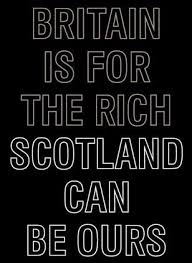
I do not believe the white paper was the critical vote winner in 2014. I think the broad vibrancy of the Yes campaign, the thousand flowers that bloomed, and in particular (for me, anyway; but I think for many others) the Radical Independence Campaign's slogan 'Britain is for the rich; Scotland can be ours' were more influential. Be that as it may...

Supposing there is a referendum, supposing Yes wins, supposing the UK government honours the result. There's a Holyrood election on 6 May 2021, which will undoubtedly happen before negotiations - with the UK, with the EU, with EFTA - are completed, and whose results will strongly influence the outcome of those elections. 

If, as the SNP assumes - the SNP is elected to govern, especially if it is elected to govern with a majority - we will see an independent Scotland built in the image of that white paper: which is to say, not very different from the United Kingdom we are leaving.

The Queen will, almost certainly, be the head of state. Lords will still lord it over us. The land will still belong to the rich. Our system of democratic governance will remain highly centralised, with enormous, profesionalised 'local government' units administering territories each larger than one sixth of all independent countries in the world. The capitalist system will remain entrenched, owning most of the nation's industry and infrastructure. We'll even keep the pound - for the time being, at any rate - and that will prevent us rejoining the EU.

I don't believe that's the Scotland Scotland wants to be. I don't believe it's even the Scotland most members of the SNP want to see. Independence which changes nothing is worth nothing.

So what do we do about it?

Lesley Riddoch, at a fringe event of the SNP conference, suggested she'd start a new party to challenge the SNP from the decentralist left. She slightly rowed back from that in her column later that week, but the idea is a sound one. In order to challenge the SNP's corporatist, technocratic vision at the 2021 election, we will need a new party. 

If it's a brand new party, of course, it's ridiculous to suppose that it can sweep to power in one bound. But that is not the point, as Lesley has said: the point is that the SNP is vulnerable from the left, and it knows it. The party has triangulated right so far and so fast in the past six years that it's left most of its members, let alone its supporters, behind.

A clear challenge from the left will push the SNP leftward. A strong challenge from localism should cause the SNP to at least reconsider its centralist bias.

The Holyrood electoral system - which I'm assuming we'll still use in 2021, since there is no current strong pressure to change it, and there isn't much time - gives space for small with broad support across Scotland. That 2021 government will be critical to the shape of Scotland for a generation at least, since it will supervise the process of agreeing a constitution. It is critically important to have influence in it.

A government of all the talents in which Lesley joined Andy Wightman, John Finnie, Maggie Chapman from the Greens, Tommy Sheppard, Alison Thewlis, Mhari Black, Mairi Gougeon, Jeanne Freeman and Mike Russell from the SNP would build a far more interesting Scotland than our current SNP cabinet.

And if we're to have such a party in place - if a new party is, indeed, needed, because it may be that what we should do is join the Greens - we can't wait, as Lesley suggested, until after independence. We need to start putting a platform together now. Yes, we can lift a great deal from work already done by Lesley herself, by Common Weal, Radical Independence and others, but we would need a clear, coherent platform, and that would need to be constructed.

I think it's time to party.

Friday, 29 March 2019

Brexit: selfishness, short-termism, rent seeking, and hereditary privilege

selfishness, short-termism, rent seeking, and hereditary privilege
Brexit: We got into this mess because some Conservatives couldn't cope with the fact that we weren't the top power in Europe: because, while we won almost all of the votes Europe ever had, it wasn't quite totally all. They couldn't cope with the fact that Germany was more influential than us - because Germany outperforms us at manufacturing, finance, exports, and, critically, diplomacy.

After Brexit, Germany will still outperform us at manufacturing, finance, exports, and, critically, diplomacy - and Germany will be part of the most powerful trading block in the world while we will have NO FRIENDS AT ALL.

The extent of the own goal here is staggering. Brexit will not only not fix any of the things the Brexiteers were upset about, it will make all of them MUCH worse.

The Brexiteers will still blame the same boggarts: they'll blame the EU, they'll blame Germany. But the problems aren't in the EU or Germany, they're in our own disfunctional constitution and our own disfunctional economy. Nobody in Britain wants to face this. We all know it's true, it glares us in the face. Our national governance doesn't work. Our commercial governance doesn't work. Our industrial governance doesn't work. And the reasons are all pretty much the same across all three sectors: selfishness, short-termism, rent seeking, and hereditary privilege.

Our elites don't want to fix these things, because they benefit from them; so they direct the blame outwards. And so the problems don't get fixed. And so the whole British project becomes more creaky, more inefficient, more decrepit, more disfunctional. And we all suffer, including those bloody elites.

Friday, 1 March 2019

We'll not go

Ships leaving the Broomielaw
We’ll not go; we’ll not send back nae letters fae onywhaur -
The ships of migration can ruist on the Clyde.
We’ll not go, we will ficht here, we’ll staun or be buried here,
Lik the floors o the forest on the Broomielaw’s side

Enclosure nae mair,
Eviction nae mair,
Clearance nae mair,
Lairdship nae mair

Dunbar nae mair,
Flodden nae mair,
Pinkie nae mair,
Culloden nae mair.

We’ll not go; we’ll not send back nae letters fae onywhaur -
The time for acceptance has left on the tide
Tak a luik doon the lang road
Fae Caithness tae Gallowa’

Last nicht I lay restless, whiles I wis speirin oan
Whit th Proclaimers hae sang o oor grief an oor pain
For the savour o strawberries that hae grown in thon saut sea
O the tears we hae gret, we hae let faa lik rain.

We’ll not go; we’ll not send back nae letters fae onywhaur -
These times are passed noo, but noo we sall rise
We’ll not go; we sall scrieve here a Claim o Richt for ilkane -
There’s a nacion tae big here, an here we sall bide.

Mundell nae mair,
Carmichael nae mair,
Murray nay mair,
May nae mair.

Province nae mair,
Region nae mair,
Devolution nae mair,
Union nae mair.

Dunbar nae mair,
Flodden nae mair,
Pinkie nae mair,
Culloden nae mair.

Enclosure nae mair,
Eviction nae mair,
Clearance nae mair,
Lairdship nae mair

We’ll not go, we sall bide here, at hame here wi freedom
Whaur the roses an geans noo aa gailie blume
In this yird we will welcome the bairns o auld Adam
Tae aa dance a reel tae a bonnie new tune.

Wednesday, 2 January 2019

Flodden Field, revisited

Nicola Sturgeon
Scotland has history of meddling in English affairs in the interests of continental friends. It doesn't end well.

In 1513, James IV, quite possibly the best governor Scotland has ever had, tried by diplomacy to persuade England's Henry VIII to make peace with France; and failed. So he sent his navy to France in support of the French, and invaded the north of Northumberland, taking three castles but not much land.

On 4th September, at a council of war with the much larger English army closing and a field of battle agreed, the Earl of Angus - yet another Archibald Douglas - argued that Scotland had done enough for France, it wasn't our fight, and the army should come home. James, annoyed, sent Archie home, with quite a portion of the army. But he then, sensibly, moved the remainder of his army to a very strong position on Flodden Edge, from where the powerful and modern Scottish artillery would have devastating fire over the battlefield.

On the 7th of September the English general, Thomas Howard, Earl of Surrey, wrote to James saying this wisnae fair - in the words of his letter, the Scots position was a fortress. His message was 'come down and fight on the flat, like decent chaps', while carefully preventing the Scots from getting sight of the size of his own army.

So what did James do? He moved his whole army, including those precious guns, to a much weaker position on Branxton Hill; and on Friday the 9th, the English closed. As they did so they brought their own artillery and much of their army in over the Twizell Bridge, within range of the Scottish guns. The Scots did not open fire; chroniclers say that this was because James ordered them not to.

Twizell Bridge, photo By Kirsty Smith, CC BY-SA 2.0
And if you look at the site and it just screams at you. The bridge is still there. It's a single span bridge, extremely vulnerable to heavy artillery, which the Scots army had in position. If the bridge had been destroyed with the English army half across, it would have made a huge difference to the outcome. The Scots would probably have won.

They did not open fire.

Instead, James marched his army down from their position on the hill to meet the English in a marsh; and in that marsh the Scots were butchered.

There were so few Scots survivors from that battle that we do not have good accounts from the Scottish side. James himself, of course, was killed. But we know from the instructions sent to the Scots ambassador in Denmark that the surviving government in Edinburgh saw James' inexperience and folly, rather than any great generalship on the part of the English, as the cause of the disaster, and from what records we have, it's hard to disagree.

But that's not what I came to talk about. I came to talk about the People's Vote.

In March 2017, Nicola Sturgeon, certainly the best governor Scotland has had in modern times, tried by diplomacy to persuade England's Theresa May not to drag Scotland out of the EU against Scotland's will. Like James Stewart before her, she was rebuffed. She had a strong position; Scotland had voted overwhelmingly to remain, she held 56 of the 59 Scottish Westminster seats, she had a clear mandate for an independence referendum.

But Theresa May, like Thomas Howard before her, said it wisnae fair. "Now," she said, "is not the time." And instead she held a general election. The SNP's powerful and modern electoral machine was in a strong position; by standing on an 'Independence Now' manifesto it would have won a majority of Scottish seats and achieved independence while Scotland was still entirely within the EU Aquis Communautaire, making our accession to full membership a formailty.

She did not write that manifesto.

Instead, Nicola marched down off the heights and engaged the Conservatives on their own ground, seeking to keep the entire United Kingdom within the Single Market. As Archibald Douglas said, Scotland had already done our part, by voting remain. England's position in the Single Market or out of it is not our fight.

All Under One Banner, Edinburgh, 6th October.
Of course, she still won a majority of Scottish Westminster seats, but from the position of strength she started from she was bound to; the subsequent eighteen months have shown us how little that majority is worth, without decisive leadership from the top.

Nevertheless, there was still time for an independence referendum before Brexit. Of coourse we couldn't expect a Section 30 letter from Westminster, but that is a technicallity which we could have dealt with in the campaign. The Yes movement was all pepped up and ready to go, the SNP membership was at an all time high.

But no. No, you may not open fire on that exposed bridge, while the English are engaged in complex manouvres. No, we shall meet the English on their own chosen ground, by campaigning on a people's vote.

What is this nonsense? It isn't Scotland's fight! Scotland has voted. It has voted to remain in the EU, and it has voted three solid times in three years to give Nicola Sturgeon the mandate to call a referendum on independence.

Say there's a people's vote. Say Remain wins. How does that help us win independence? It does the opposite. It gives the No campaign the chance to argue once again that the quickest way to lose European citizenship is to vote Yes. So winning this 'people's vote' does not help us.

But that if, as is virtually certain to happen, Scotland again votes Remain, and England again votes Leave? Why, then, we get a reinvigorated right wing government in London ready to repeat the mantra "now is not the time" ad nauseam, and we are at their mercy as they do trade deals with America which will devastate our agriculture, our food and drink industry, our environmental standards and our health service.

Those who will not learn the lessons of history are doomed to repeat them. Just as James Stewart marched down off the hill to the total destruction of his army, his hopes, his nation, over a fight that was never Scotland's to fight, so Nicola Sturgeon is doing once again. The first time is tragedy, agreed, but the second time is too dark to truly be considered farce.

Scotland needs to be better than this. Scotland needs to grow up. Scotland needs to acknowledge that England is different from us, has different needs and priorities to us. Scotland has to learn that we cannot - and should not try to - impose our ways on our bigger neighbour. We have to fight our own battles for our own national interests. And that means, being independent in Europe.

Monday, 3 December 2018

Roads to independence

All Under One Banner - Edinburgh
With the Brexit process nearing its decisive point, I've been reading good analyses of the potential future paths by Chris Grey and Jon Worth - for the UK as a whole. I haven't seen an analysis of the future paths for Scotland which seem as good to me, although the Politics Scotland blog has had a go. I'm not saying my analysis is better or is better informed, but for what it's worth here it is.

No-deal Brexit is probable

Under the European Union (Withdrawal) Act, the UK leaves the EU at 23:00 UTC on 29th March 2019, whether we have agreed deal or not. That is less than four months away now, but it's four months which includes the Christmas and New Year holidays, so in practice it is more like three.

There is no majority in Westminster for the negotiated deal. There is a theory that, having failed in the vote on Wednesday 12th December, May could return to Brussels, negotiate some trivial face-saving tweeks, bring essentially the same document back to parliament and have it pass; I don't believe that is likely.

I think it much more likely that the vote on the 12th will fail, probably heavily; and that in the wrangling and chaos which results, the clock will run out. To me, just now, a no-deal Brexit looks virtually inevitable.

A 'snap election' won't happen

Under the Fixed Term Parliament Act, an early election requires two thirds of MPs to vote for it. Almost half of all MPs are Tories, who know they would be very heavily defeated in an election held now. Turkeys don't vote for Christmas.

A second EU referendum is irrelevant

There's a lot of folk arguing for a second EU referendum. I don't think that will  happen, but it could. For it to happen, all of the following would be required:

Theresa May would have to be replaced as Prime Minister. I don't believe she'll resign. She is under a very great deal of strain, and might have a health breakdown; more probably, there could be a vote of no confidence in her or her government.

A Vote of no confidence in May by Conservatives would require that 48 letters of no confidence from Tory MPs are sent to the Chair of the 1922 committee. The European Research Group have been trying hard to achieve this total, and have clearly failed; however, losing the vote on the 12th could change that.

But if the total were achieved, a Tory leadership election would take time, and, given that the membership of the Tory party are much more extreme Brexiters than the population as a whole, such an election is very unlikely to produce a leader who would support a second EU referendum.

A vote of no confidence in the government by parliament would require all of the opposition parties (including the DUP) to vote together. It's unlikely that all Labour members would vote against the government, but a few Conservatives might, so it's possible that this would pass. What happens next is tricky. Corbyn would have an opportunity to form a government, which would require all the parties other than the Tories to form a coalition.

Tories would need to cross the floor. Corbyn himself doesn't want a referendum; the DUP definitely don't; so such a government would be unlikely to support a referendum. The only possibility there is if some Tory MPs (possibly Sarah Wollaston, although it's hard to think of many others) crossed the floor to join 'a government of national unity', which would not include the DUP.

The EU would have to agree to an extension of Article 50, even if a government prepared to hold a referendum could be formed. The new government could not be in place before January at earliest; a referendum campaign takes considerable time; if an extension is not agreed, then the clock will run out.

The second referendum probably wouldn't change things. Polling on a second referendum indicates that the UK as a whole is still split about 50/50 within the margin of error. There has not been a decisive swing from leave to remain. Furthermore, we have not effectively addressed the problem of dark money; hostile actors, including foreign actors, would continue to successfully funnel money into the leave campaign. I think we would again see Scotland, Northern Ireland and London voting to remain, England and Wales voting to leave.

A second independence referendum has grave problems

I have been working since September 2014 for a second independence referendum. I now think
  1. It's unlikely to happen;
  2. It's unlikely to be seen as legitimate;
  3. We're unlikely to win it.
It's unlikely to happen because the SNP are too timid to even call it unless independence is well ahead in the polls, but, without a focussed campaign, we won't get there. No one but the Scottish government can effectively call one, and it will take decades to build up a new pro-independence party to the point that it can force the SNP to move out of the way.

Even if it happens, it's unlikely to be seen as legitimate. Although Keith Brown argues (and I agree) that Holyrood alone has the authority and the mandate to hold an independence referendum, a section 30 order is almost certain to be refused. The unionist parties - the Tories, Labour, and the Liberal Democrats - will use this to claim that the referendum is illegitimate, and will very probably campaign for a boycott. If the No campaign effectively boycott a referendum, the result would only be seen as legitimate if substantially more than 50% of the entire electorate voted Yes - because, in the media, all those who didn't vote would be assumed to support 'No'.

An independence referendum only succeeds if the rest of the world sees it as legitimate. If other governments - especially those in the EU - don't recognise the government of Scotland as sovereign, we've failed.

But in any case we'd be unlikely to win it. We are no longer holding the referendum from within the EU. From within the EU, while the whole aquis of European law held in Scotland, the negotiation would have been relatively easy (except fishing); and it would be preserving a large proportion of the status quo, which would give cautious voters confidence. By contrast, a second independence referendum could now happen only in the chaos of disentangling the UK from the EU, or after the Brexit dust has largely settled.

After the Brexit dust has settled, in a much poorer nation with a very recent memory of years of painful disruption, I think it would be hard to motivate any electorate to vote for major constitutional change again. Certainly it would be very easy to run a No campaign on the slogan 'no more chaos'. Also, after the dust has settled, new trade deals with the US will rapidly lead to a selloff of key state assets to American companies, and I do not see how we could protect the Scottish NHS from that. I don't believe we can afford to wait for the dust to settle.

But while Brexit is in progress, the unionists will still be able to paint a picture of the coming 'global Britain', and the 'sunny uplands' of new trade deals which will at that stage still be in fantasy land and thus capable of being painted in glowing colours. That will of necessity push the Yes campaign into a 'project fear' position, where we will have to be continually pointing out the risks - of losing the NHS, of losing our GM-free status, of losing our health, employment and environmental protections, of competing on labour rates against developing economies. Negative campaigns can win, of course, but I don't think that's a style of campaigning we'd be comfortable with.

'Business as usual' may not contine 

Human beings are programmed to believe that tomorrow will be very much like today, next year very much like this year (damn, I hope not!). We assume business as usual will continue. But if we have a no deal Brexit - which, I reiterate, I think almost inevitable - it won't. Our supply chain is very fragile. Supermarkets keep stocks of only a few days' food and groceries. Much of our food comes from Europe. Chaos at the ports will very rapidly lead to shortages, which would lead to panic buying, which would lead to empty shelves.

The British are not used to going hungry. Social order would rapidly break down. There are already plans to deploy the army on the streets.

If a State of Emergency was declared, elections would almost certainly be suspended. It's quite likely that Holyrood would also be suspended, especially if there was a significant push for independence. As senior MSPs are unlikely to consent to Holyrood being suspended, it's likely that many would be interned; it's likely that influential Yes movement figures would also be interned.

In this scenario, independence would be literally impossible without civil war, and that is not a road I want to go down. So let's assume (for now) (and devoutly pray) that this dark fantasy of mine does not happen, and go onto more optimistic options.

An 'Independence Now' manifesto would work

As Margaret Thatcher repeatedly pointed out, and as the Irish precedent shows, all that is required under the British constitution to achieve Scottish independence is for pro-independence parties to win the majority of Scottish seats at Westminster - as, actually, the SNP did at each of the last two Westminster elections and almost certainly will at the next.

Of course, at the last two election, the SNP did not stand on an 'Independence Now' manifesto. If they did, they could make every Westminster election until independence a de facto independence referendum. Of course, it's likely that the unionist parties would join forces to put up just one candidate against the SNP, but that actually plays in the Yes movement's favour - because such candidates would inevitably either be Tories or be in explicit alliance with Tories.

There are three possible outcomes:
  1. We don't win a majority of seats, in which case nothing is lost and we can try again next time;
  2. We win a majority of seats and a majority of votes, in which case we have a clear mandate to immediately negotiate independence;
  3. We win a majority of seats but not a majority of votes, in which case we'd be well advised to negotiate for maximal devolution but could still try again next time.
Consequently, I think the 'Independence Now' manifesto is now the best strategy for the movement. Obviously it would be best if the SNP were to stand on this Manifesto. But if they won't, I think that the Yes movement should think very seriously about putting 'Independence Now' candidates up against the SNP in all Scotland's constituencies.

Monday, 9 July 2018

The Growth Corruption

Andrew Wilson with Nicola Sturgeon, 


Andrew Wilson is managing partner of a lobbying firm, Charlotte Street Partners. There's no secret about that. The business of Charlotte Street Partners is to lobby the Scottish government in the interests of commercial companies. There's no secret about that. When Nicola Sturgeon appointed Andrew Wilson as chair of the growth commission, she knew this; there's no question about that.

What is secret is who the clients of Charlotte Street Partners are: who actually pays this piper. We don't know. We don't know whether Nicola Sturgeon knows.

Among the members of the Growth Commission were a number of business people; there's no secret about that. Nor is there anything inherently corrupt about that - any commission looking into the economy needs to take cognisance of the interests of business. For the record, they were:
  1. Dan McDonald, businessman and founder of N56 group
  2. Marie Macklin CBE, Founder and Chief Executive of the Klin Group and Macklin Enterprise Partnership
  3. Mark Shaw, Chief Executive, Hazeldene Group
  4. Petra Wetzel, founder and Managing Director WEST Brewery
Again: there is nothing inherently wrong with businesspeople taking part in this commission, and their taking part does not say anything against them. But we don't know whether any of these people is a client of Charlotte Street Partners.

The commission met with 22 trade bodies, and, again, there's nothing wrong with that; you'd expect them to. Full disclosure, the Chief Executive of ScotlandIS, one of those 22 trade bodies, is my sister.

At each meeting with a trade body, some members of that trade body participated; the minimum number was three, the maximum was twenty. It's entirely proper that when the commission met with a trade body, some members of that body should be present, and should put their views.

The commission report notes in section 1.15 that these meetings were held 'under Chatham House Rules'. What does this mean? It means this:
"When a meeting, or part thereof, is held under the Chatham House Rule, participants are free to use the information received, but neither the identity nor the affiliation of the speaker(s), nor that of any other participant, may be revealed."
Again, there's nothing inherently wrong about this. Chatham House rules are used to allow people to speak frankly, and frank speaking is what a commission such as this needs.

But something stinks, and it is this: we don't know which companies spoke with the commission at these twenty-two meetings, we don't know what was said, and we don't know which of them were clients of Andrew Wilson's firm. What we do know is that the growth commission came up with a set of recommendations which were extraordinarily favourable to the interests of the rich.

I think there are questions for two people to answer here. One is Nicola Sturgeon. She needs to explain why she chose a corporate lobbyist to lead this very important commission. Yes, I acknowledge that Andrew Wilson is a member of the SNP, I acknowledge he is a member of the Scottish Great and Good, and I acknowledge he is an economist. But, actually, the SNP is not short of members who are well regarded, economists, and not corporate shills. So why Andrew Wilson?

For Andrew Wilson there are more questions. Has any member of the commission ever been a client of Charlotte Street Partners, and if so, whom? Has anyone the commission had meetings with been a client of Charlotte Street Partners, and if so, whom? Did any client of Charlotte Street Partners have early sight of the Growth Commission report, and if so, whom? Did any comment on it, and if so did any such comment result in changes to the text? If so, whom, and what changes?

In a small nation there is a short step from cronyism to outright corruption. Andrew Wilson's business - the representation, for money, of undisclosed interests in undisclosed meetings with undisclosed senior members of government - is also a very short step away from from outright corruption. So, I say again: we need, very clearly, to know which of Andrew Wilson's clients were given the opportunity to influence the growth commission report.

Thursday, 28 June 2018

Another letter on the Copyright Directive

The European Parliament
Dear Nosheena Mobarik, Alyn Smith, David Martin, David Coburn, Catherine Stihler and Ian Hudghton,

I wrote to you all in early April regarding the proposed Copyright Directive. Unfortunately, I had constructive engagement only from David Martin. The matter is now urgent, since you will be voting next week; so I shall try again to state my case.

The proposed copyright directive:

1. Undermines the modern economy
2. Undermines internet security
3. Reduces the rights of citizens
4. Undermines civil society

I'll expand briefly on each of those points in turn.

The modern economy is built largely on the Internet, which in turn is built largely on open source software. Without open source, none of email, the World Wide Web, Facebook, Twitter, or thousands of other services the modern economy depends on would not be possible at all. Open source is software created and given away at no cost: a gift to the public commons. It is created by academics and corporations, but primarily by individuals. There's no profit made from this; consequently, it is extremely vulnerable to costs. Open source software is shared on sites like Github and Sourceforge, which in turn make little profit. Content upload filters will literally kill the golden goose.

Internet security is both based largely on open source software and requires the sharing of highly techincal information about software vulnerabilities. Many people - both individuals and in academia and businesses, across many countries, co-operate to identify and find fixes for vulnerabilities. Consequently, the information shared almost inevitably includes exerpts of proprietary material. Again, content upload filters would stop this activity stone dead.

Citizens have a right to freedom of expression and freedom of creativity. Art has always involved building on other art. No tune, no picture, no movie is completely unlike any other, and knowing reference to other creative productions, either as homage or as satire, is a trope in every sphere of human expression. Snow White, Cinderella and Pinochio were folk tales in the information commons of Europe long before the Victorians gathered them into books and Walt Disney monetised them into movies. The whole principle of long term copyright is an abuse against freedom of expression.

Civil society involves debate, much of which, today, happens online. To comment on and either expand or rebut the arguments of other voices in the debate requires both quoting and referencing, both of which fall foul of the proposed directive. The citizens right of civic engagement will be gravely damaged.

You'll note that in the above argument I've made no comment on the feasibility of building foolproof content filters as envisaged in article 13. As a software engineer, I know that filters of the quality and subtlety required cannot be built, but that is beside the point. Even it they could be built, the social and economic costs of deploying them would be vastly damaging, not simply to Europe but to the world.

I urge you in the strongest possible terms to reject the proposed Copyright Directive in its entirety.

Yours sincerely,

Simon Brooke

Tuesday, 29 May 2018

Limits to Growth

Wealth.

A lot of folk have commented excellently on the Scottish Growth Commission report. A lot of folk on the left have been critical. George Kerevan, in particular, has lambasted the SNP for promoting a regressive, over-cautious, Morningside-friendly version of Independence Lite, writing:
"Working-class folk, especially those who are unemployed, unskilled and dependent on benefits, are the most likely to vote SNP. They provided the bedrock of support in 2014 that nearly won us independence. The Rowntree report argues forcibly that unless the SNP directly address the needs and aspirations of this core demographic, they will lose support to Labour and the Tories."
George is right, of course. I agree with him, of course. But actually, although I have many criticisms myself, I'm not too worried by this. From the point of view of an independence referendum, it doesn't matter. The SNP can wave their Growth Commission report in the faces of the 'soft no' voters in Morningside and Bearsden, Cramond and Newton Mearns. They may swing a few voters, and if they do, that's excellent.

But in the meantime, the left - Radical Independence, the SSP, RISE, even the Greens - can be presenting a far more radical, adventurous, egalitarian, internationalist vision of independence to working (and not-working) Scotland, and that's where the referendum will be won.

But that's also where the Growth Commission threatens to lose it for us. A report written to tempt the comfortable middle class does not go down well everywhere. Darren "Loki" McGarvie writes:
"the party I once voted into power, believing they could deliver an imaginative, “trouble-making” form of independence, have produced an economic prospectus so demoralisingly timid... if the big idea is simply to rebrand the fundamentals of the UK economy, so that independence becomes more attractive to those whose entrenched advantages are threatened by a radical alternative, well, that’s a very different proposition, isn’t it?"
Loki usually irritates me, but he represents a large section of 'soft yes' opinion; and in this piece he's only saying what I have said myself many times: independence which changes nothing is worth nothing. The very document which may win us a few 'soft no' voters threatens to lose us a lot more 'soft yes'.

My analysis of the Labour party has been for years that while its core vote was working class, its parliamentarians - and particularly its front bench - are drawn largely from an Oxbridge-educated elite. Their parliamentarians don't socialise with their electorate; they don't understand them. Consequently they have to send out ethnographers to do focus groups to discover (often imperfectly) what their electorate thinks.

The Growth Commission report emphasises that the SNP have fallen into the same trap. Their electors, too, are largely working class - and largely urban working class. Yet their parliamentarians are bankers, lawyers, journalists; suit-wearers. The Growth Commission report speaks to Morningsiders because SNP politicians are themselves Morningsiders. It doesn't speak to Easterhouse or Castlemilk because SNP politicians don't socialise with Easterhouse or Castlemilk.

This is the root of SNP timidity. They think the time is not right for a referendum because, in the circles in which they move, the time is not right for a referendum. They think caution, fiscal prudence, independence-lite will swing the vote because for the people with whom they socialise that is what would swing the vote.

Of course, if the SNP do dawdle, dally, and delay the referendum until after the next Holyrood election, George is right and I am wrong. The SNP have over the past decade run Scotland considerably better than any of their predecessors, but they have also made mistakes, and there are several policy areas on which they are now looking a little tired.

If they delay until 2021, if they don't radically change direction to appeal to working Scotland, then there really will be no independence referendum for a generation, because there aren't enough 'soft no' voters in Morningside to balance a 'soft yes' that sees no benefit in an independence which changes nothing.

But to get down to detail of Growth Commission report, and to my own criticisms.

The report says:
"3.88 Maximising frictionless trade and market access with the rest of the UK and with Europe is of critical importance to the performance of the Scottish economy in the short and long term."
This is almost certainly not possible, and absolutely certainly not in our gift. England and Wales (hereinafter EW - and note that I'm rather assuming we'll see a united Ireland before an independent Scotland) seem destined for a very hard crash out of the EU. Given that that is so, there will be a hard border between EW and any country which is in either the EU or EFTA. Scotland will have to choose which side of that border to be on. Do we choose the UK side, which makes independence virtually meaningless, or the EU side, which puts us into a community of 27 other nations many of a similar size to our own?

This decision is made harder by the fact that England sits squarely across our main trade route. Trade war with EW is precisely what undermined the Scottish economy before the 1706 union; it is a major risk. Scotland urgently needs its own Brexit Buster, like Ireland's. That means not just ships, but new port infrastructure (and transport links to it) at Grangemouth, Rosyth, possibly Aberdeen.

The Growth Commission report covers port facilities only in paragraphs A183 and A190; it doesn't mention the risk of trade friction in using EW as our main trade conduit - friction which could arise out of hostility but is equally likely to be simply a consequence of incompetence and dislocation of an economy collapsing under the weight of Brexit. For the commission not to have acknowledged this and allowed for it seems to me pretty remiss.

Related is the matter of currency. The report urges the idea of continuing to use Sterling for what seems to me a remarkably long period (10 years).

As Kirsty Hughes persuasively argues, using Sterling prevents us rejoining the EU during that period. If she's right (and I believe she is), shouldn't the Growth Commission have considered this? But even if she were wrong about EU membership, for a country which wishes to remain part of the European family to hitch itself to a currency set to diverge rapidly from it doesn't seem like a good plan.

I'm also bothered by the 'Annual Solidarity Payment'. It looks a lot like tribute; or like paying off a blackmailer. We shouldn't do this.

Article 38 of the Vienna Convention on Succession of States in respect of
State Property, Archives and Debts reads:
"1.When the successor State is a newly independent State, no State debt of the predecessor State shall pass to the newly independent State, unless an agreement between them provides otherwise..." 
So Scotland is not obliged to, and cannot be obliged to, pay a share of the UK debt. This doesn't mean we should not, but it does mean we cannot be forced to. The risk that concerns me is that EW will assume it is entitled to payments from Scotland, and will behave badly - for example, by holding up Scottish exports - in order to try to screw more money out of us.

The Growth Commission report compounds this problem by suggesting that we should continue to 'buy services' from EW as part of the 'Solidarity Payment', specifically including military services. For me, making a break from the UK's military traditions of bombast, adventurism, gunboat diplomacy is one of the most important reasons for independence. I don't think I'm alone. Again, UK foreign aid is increasingly being used to pursue the UK's geopolitical and commercial ambitions. Scotland should not be supporting UK foreign aid programmes (para B2.3).

But there's a more fundamental issue about the Growth Commission report: growth. Sustainable growth is physically possible only if you assign artificial financial values to intangible things. We currently do do this, but we shouldn't assume it's beneficial.

Does the Scottish economy need to grow at all? I'd argue it doesn't. According to 'Wealth and Assets in Scotland, 2006-2014', the total household wealth of Scotland is £865.6 BILLION - almost a trillion pounds.

I own ten acres of land, a car with 130k miles on it, a 55 year old tractor, five cattle, a little sailing boat, several computers, a lot of books, several bicycles, a home-built house you would call a hut, and some tools; total value £70,000 if I'm lucky. Yet, apart from mental health, I have an extraordinarily good life. I work about ten days a month. I eat well. I'm secure. There's nothing I need I don't have. Of course, I don't have a partner or children, but if I did have, it would not take three times my current wealth to provide all of us with a very comfortable life.

The average household wealth in Scotland - the arithmetic mean - is £360,666.67. You don't have that much? I'm not surprised. The problem isn't that Scotland is poor, the problem is that Scotland is unequal. Worse, Scotland is still steadily getting more unequal.
Chart of household wealth per decile over time, showing increasing inequality.
Yet more than half of all households have no or negligible net financial wealth.


40% of all households have no or negligible property wealth (and you can bet those are mostly the same folk as have no net financial wealth).


In fact, overall, this is how badly wealth in Scotland is distributed. Iif we shared Scotland's household wealth equally, 88% of households would benefit. Only 12% of households would lose. And that is before you count wealth held in tax havens and secrecy regimes.


So, going back to that average figure, £360,666.67. Suppose your household had that much wealth. Would you be able to live an extremely comfortable life?

I would think so.

If you couldn't, what is wrong with you?

Inequality is the elephant in the room of independence. A plan for independence which does not radically address inequality will not attract a majority of Scotland's voters. Any major constitutional change is a risk - as we are seeing with Brexit. People - perhaps Scots especially - are wary of risk. People take risks only when the potential benefit is considerable, and independence which changes nothing offers no benefits. We have to have an independence plan which offers the prospect of a radically fairer Scotland.

We can do that. It really isn't hard.

And if the overwhelming majority of us could live very comfortably indeed on a fair share of Scotland's wealth, why does Scotland's economy need to grow? Why is it seen as a political desideratum?

We cannot grow by resource consumption without destroying the future of the planet for our children. We cannot extract all the oil from under the North Sea without far exceeding the planet's ability to cope. We need to use the resources we do extract more thoughtfully. We need to waste less. We need use less. All this can be done without hurting anyone's standard of living.

In summary, if we made our political objective to make people's quality of life better, rather than to grow the economy, we have adequate wealth and would have, with independence, adequate tools to do that.

The question is, have we the will?

Friday, 27 April 2018

Of foxes, and kings.

Red fox. Photograph: Jonn Leffmann, CC BY 3.0, Link
Does a social system with entrenched privilege systematically breed progressively nastier people? I suspect it does, and I shall argue it.

I used to believe that the reason the British elite are in general such noxious people was because our system of elite education is so bad; but I've begun to doubt that that's the whole story.

Elites tend to breed with elites, in quite narrow parameters: people tend to choose mates from socially similar backgrounds. Historically at least, elites have tended to have greater breeding success; they've had more children who have survived long enough to breed themselves. This is illustrated by programmes like "Who do you think you are": if you examine random people's family trees, royalty crops up surprisingly often.

The social systems we've had in Western Europe since the bronze age - warrior cultures, the feudal system, capitalism - have all tended to entrench privilege. Wealth and, to a degree, social status have been heritable.

And the characteristics required to ascend the ladder in all those systems has included the preparedness to be more ruthless, more ambitious, more bellicose, more vicious. (Obviously other characteristics have also been selected for: intelligence, charisma, physical attractiveness, and, at least until the end of the feudal period, strength).

Are characteristics like ruthlessness and bellicosity genetically heritable? I used to believe not; I used to believe that they were software, engendered by nurture, not hardware, engendered by genetics. The Russian fox domestication experiment persuades me I was wrong. By selectively breeding the tamest individuals, the experiment produced systematically different behaviour in foxes over remarkably few generations.

If characteristics like tameness are heritable, so, too, surely, are characteristics like ruthlessness.

If so, our social systems have since the bronze age systematically bred an elite which is progressively more ruthless over many generations. And worse, because elites have, historically at least, tended to have greater breeding success, we have progressively bred a general population which is more ruthless. (Of course, yes, other more desirable characteristics are also selected for).

If you look at the current Tory front bench, or the upper reaches of the aristocracy, or, indeed, those areas of law, finance and journalism where entry is selected on the basis of elite education, this thesis accounts for what you observe remarkably well.

So, if we have selectively bred a more ruthless, more vicious population than our "savage" ancestors, can we reverse the trend?

Heritable privilege seems to me to be key here. If you break the chains of inherited wealth and privilege, you'll get a sort of reverse eugenics - greater genetic mixing. That doesn't necessarily select for nicer, more cooperative, more sociable people, but at least it would stop us preferentially breeding worse ones.

As Comrade Lucy Broon put it,  'Just scrawl "full communism now" on rahbackuvvah silver rizla'

Thursday, 12 April 2018

Mourning goose

The Goose That Laid the Golden Eggs,
illustrated by 
Milo Winter
The last thirty years have seen an extraordinary change in the technical substrate on which our culture is built. The World Wide Web, created in Europe in in 1989, made the Internet usable for non-technical people. Across the Web, the vast majority of servers run on Linux, an operating system written in Europe between 1991 and 1993, as do the vast majority of mobile phones, and many of the Internet's routers. Meantime, most Apple products - computers, phones and tablets - are built on the BSD operating system, as are many other Internet routers.

Facebook, the towering proprietary monolith of social media, was built on PHP, a web scripting language written in Canada by a European (strictly, a Greenlander), as are all Yahoo's and Wikipedia's web services. Twitter was built on Rails, a web framework written by a European working in the US.

What's key about all these critical products is that they are all open source: given away by their authors for free as a public good, a newly created common wealth for the whole human race. These gifts - because they are gifts, and critically valuable ones - have sometimes been made by corporations, and often by universities.

But nevertheless, the most important gifts have been made by individuals: people who have chosen, rather than get personally rich on the basis of their creative work, to make a gift to all of us. And as these gifts have been maintained, developed, improved and repaired over the years, a great deal of that work has itself been done by individual volunteers, seeking no reward but their reputation among their peers.

It is on these acts of unselfish generosity, these gifts, that the whole of the the modern economy is built; and that isn't accidental.

The World Wide Web was by no means the first distributed hypermedia system; it was the first to be widely adopted, precisely because it was the first that individuals and organisations could adopt without onerous costs and licence terms. Linux is now the dominant operating system on the planet not only because it's free, but mainly because the ease with which people can contribute fixes and new functionality allows it to develop, and fix vulnerabilities, faster than commercial alternatives.

Open source not only reduces the cost of business innovation, it also drives up quality and enables business to share the costs of maintaining key software assets. It is the goose that lays the golden eggs on which the modern economy is built.

And the European Commission is proposing to shoot it.

The proposed Copyright Directive - and in particular Article 13 - totally undermines the gift economy; it poses unaffordable costs and liabilities on code sharing repositories like SourceForge, GitHub, GitLab and others. These organisations will be forced to either withdraw or charge for their services. making it impossible for volunteers to freely share - to gift - their own work.

Meantime, Article 11 seeks to undermine another critical substrate of a free society, the free and voluntary sharing of ideas. The civil society discourse on public policy requires citizens to be able to freely access and reference the ideas of others in their own works, and to make their own works freely available to others to reference, comment upon and critique.

Of course, the European Commission isn't setting out to shoot the golden goose. It's setting out to protect the interests of the film, television, and fiction publishing industries. But seriously, is it better in the modern age to have films and no internet, or internet and no films? If our present copyright provisions meant the total elimination of Europe's cinema and television production sectors, would the total destruction of the infrastructure of the Internet be a price worth paying to save them? If our present copyright protections meant the elimination of journalism, would the destruction of civil society be a price worth paying to save it?

No, obviously not.

And cinema and television production are not greatly challenged; they're thriving and immensely profitable. Journalism is challenged, and is still adjusting to the Internet. But nevertheless, the solution to that is not - cannot be - to destroy either the Internet or civil society.

This is a directive that should not merely be reconsidered; it should be abandoned entirely.

The discussion we should be having, in an age in which the cost of reproduction of digital goods is essentially nil, is whether the copyright model which served reasonably well through the era of print serves any sort of public interest in the digital age.

Of course the creators of cultural artefacts deserve to be rewarded; of course journalism is necessary to a free society and must be supported. But copyright does not serve either purpose well. For every J K Rowling, there are a thousand authors of fiction who make at most a pittance; for every Paul McCartney, a thousand songwriters struggling to put petrol into the car to go to their next gig.

In journalism, the Daily Mail, a purveyor of gossip, malice and deceit, profits more from copyright than the Guardian, which supports serious political discussion and commentary, and funds critical investigative journalism such as the recent Cambridge Analytica scandal.

In the Hitchhikers' Guide to the Galaxy, Douglas Adams wrote a little parable for our times. The first settlers of Earth, he wrote, adopted the leaf as currency. But leaves were too plentiful; so in order to prop up the value of the leaf, they decided to burn down all the forests.

What the European Commission is proposing is to burn down the forest: to save the profits of the media industry by destroying the infrastructure of the Internet and of civil society. They must not be allowed to do this. Copyright is a tool of society, not its master; and if the tool has been made obsolete by more modern technology, it is time to discard it.

Creative Commons Licence
The fool on the hill by Simon Brooke is licensed under a Creative Commons Attribution-ShareAlike 3.0 Unported License