I got into a foolish Twitter dispute last night, and ended up saying
something I fundamentally think to be true. People will say, and with good reason, 'oh, Simon's gone off on one again. He's mad, you know'. And, of course, it's true. I am insane. A really frustrating consequence of that is that sometimes my judgement is seriously wonky. But it also means I can say thing that other people are too sensible to say. Let's explore this idea.
Firstly, to roll back a little, I do not believe that anyone is irredeemable. 'Evil' is not a word that should be applied to people. And, I believe,
usually, people who do evil things do so because evil has been done to them.
So this is an essay about the pathologies of power.
I want to examine a number of things:
- The Bulingdon Club, and Alpha Epsilon Pi
- Grouse moors
- Jeffrey Epstein, and child sex abuse
I will argue that these are on the same spectrum.
To demonstrate huge wealth is not difficult. One merely has to drive
a gold plated Lamborghini. To have power, one has to be able to use it. One has to be able to do things which other people, people with less power, cannot do. And one has to be able to do these things with impunity. To show to others that one has power, one has to actually do things which other people cannot do: one has to use power performatively. And, indeed, this is the only way one can answer the question, 'how much power do I have?'
The
Bullingdon Club is a club for very rich young men at Oxford University, it has been in existence for more than two hundred years, and with very much its present reputation for at least one hundred years. The reputation of the club is for extremely bad behaviour, with records of extreme destruction of other people's property from as early as 1894 to as recently as 2010.
Apart from wrecking country houses and restaurants, notorious Bullingdon practices include
1. Forcibly removing the trousers of members of the public;
2. Burning £50 notes in front of homeless people;
3. Bestial necrophilia.
Alpha Epsilon Pi is not quite as elite as the Bullingdon Club. It is a 'fraternity' of university students at a
number of universities, originally in the US, but including, specifically, St Andrews in Scotland. The chapter at St Andrews in particular has been associated with a
startling number of allegations of rape. (Dani Garavelli wrote
a very good piece which refers to the Alpha Epsilon Pi allegations in Scotland on Sunday this week)
All just young men's high spirits, don't you know? Or a systematic way for rich young men to explore just exactly how much bad behaviour they can get away with?
Very well. Let us move on to child sexual abuse and the sexual exploitation of very young women; and the very large number of allegations around it which centre on rich and powerful men.
Not all allegations of child sexual abuse are associated with powerful people, of course; that's not what I'm arguing. What I'm arguing is that the pathology of power draws people to explore what they can get away with. Child sexual abuse is the crime which in our modern society is most reviled and most stigmatised (and with reason). If you want to demonstrate that you can get away with anything, this is the Everest, the pinnacle.
What I'm arguing here is that the attraction of child sexual abuse to very powerful people is not (at least mainly) an erotic attraction to very young bodies, just as
the alleged sexual act between a former prime minister of the United Kingdom and a dead pig was not primarily about the erotic attraction of pork. On the contrary, both are, at least in part, a pathological need to explore the limits of power.
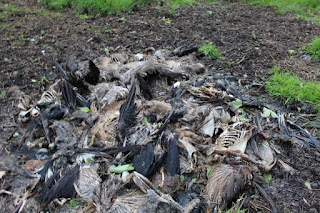 |
Corpses of grouse, pheasants and geese
left to rot (source)
|
Which brings us on to grouse moors. Grouse moors represent the environmental destruction of large areas of countryside in order to provide an opportunity for a very few people to slaughter a large number of birds - birds which are not particularly good eating and which are in fact largely dumped and left to rot for this very reason.
The grouse, like the child sexual abuse victims and the dead pigs, are not being shot for their intrinsic value; they're being shot for their trophy value: to prove that the shooters can get away with it.
So what is it they're 'getting away with'? Shooting a few wild birds does not seem so shocking, surely? Well, no. But in order to create the environment in which birds can be shot in such numbers, hundreds of people must be driven out of their homes and off their ancestral lands.
Enclosing commons was how the powerful of the seventeenth and eighteenth centuries demonstrated their power. They had the power to drive the common people out of their homes and off their land, and they did. Having enclosed the commons, of course, they could then farm the most productive parts more intensively (or at least, rent them out to farmers, who would do so, at high rents) and make profits.
But a large part of the lands from which they had driven the subsistence farmers could not be farmed profitably in any other way, so what to do with it? The answer was to create vast deserts on which to slaughter small birds.
Just as, as feminists keep saying,
rape is not (mainly) about sex, so enclosing the uplands is not mainly about improving agriculture - the new 'improved' agriculture could make no use of such marginal land. What had been, from April to September, the summer shieling of tens or hundreds of thousands of subsistence farmers, became an arena, for a few days in August, to display the power of the few.
Solitudinem faciunt, bona appellant.
Birds of prey - especially large birds of prey - are the most visible of the iconic species of our wildlife. Wildlife is not the 'property' of anyone: rather it is a commons for us all. Birds of prey eat meat. Not huge amounts of it, but it is what they eat. I find the idea that eagles or red kites significantly predate on red grouse improbable. Hen harriers, of course, will do so, where grouse are abundant.
There is a certain bitter rationality to gamekeepers slaughtering hen harriers, wild cats, foxes and stoats on grouse moors: the gamekeepers are paid to provide plentiful easy targets for their employers to take aim at. Predators which predate on ground nesting birds will necessarily reduce that plenty. This is how ecosystems work, after all.
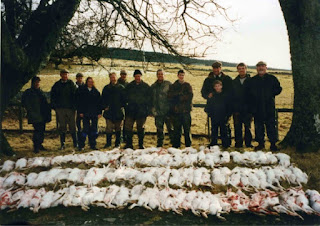 |
Mountain hares killed on a single day on
a single estate in the Angus glens (source)
|
But the fact that
eagles, kites, pine martens and
mountain hares are also slaughtered indiscriminately on grouse moors is evidence that this isn't about bitter rationality, or any rationality at all.
The fact that ordinary people - people who are not powerful - take pleasure in seeing eagles, kites, hen harriers, ravens, wild cats, foxes, stoats and mountain hares - mountain hares! - is the only reason to exterminate them. It's a naked demonstration of power over the commons. Power to steal, to desecrate, to destroy, and to do so with impunity. Wanton and blatant destruction of common goods. Bad behaviour performed solely for the purpose of showing that you can get away with bad behaviour. And this, I claim, is evil.
Wherever you find rich and powerful people wishing to demonstrate their wealth and power, you'll find others who make their living by enabling it. The
Oort cloud of lawyers and estate agents who orbit Londongrad are an example.
So
Ghislaine Maxwell was, in effect, Epstein's grouse moor manager. She organised the provision of plentiful easy targets for him and his friends to take aim at, and managed the arenas in which they bagged their trophies.
What I'm arguing here is not that grouse moors are 'as bad as' child sexual abuse - clearly, in terms of direct harm to specific individual people, they are not.
But I am arguing they are on the same spectrum, driven by the same pathology.
And the reason that this matters - the reason that I believe we should look on the owners of grouse moors with the same eyes as we look on those people in the other categories I've discussed - is that it people have a propensity for performatively extremely bad behaviour in one aspect of their lives, it is highly probable that they are exhibiting equally unacceptable behaviour in others.


